

If you think you might be pregnant and you do not have health insurance, you may be wondering where to get an ultrasound without insurance, and what it will cost. Those are fair and practical questions. An early ultrasound can tell you things a home test cannot, and knowing your options ahead of time can make the next step feel less overwhelming.
This guide explains what an early pregnancy ultrasound shows, what one typically costs if you pay out of pocket, the kinds of places that offer them, and how women in Southfield, Detroit and across Metro Detroit can get a free limited ultrasound when they qualify.
Quick answer
Without insurance, a pregnancy ultrasound often costs a few hundred dollars, and national averages run around $459 for a routine fetal ultrasound. Lower-cost options include community health centers and outpatient imaging centers. Some nonprofits, including Problem Pregnancy Center in Southfield, offer a free limited ultrasound to women who qualify.
In this article
- Why get an ultrasound early in pregnancy?
- How much does an ultrasound cost without insurance?
- Where to get an ultrasound without insurance
- What is a limited ultrasound, and what can it show?
- Where to get an ultrasound without insurance, and when to go
- Where to get an ultrasound without insurance: how to prepare
- Where to get an ultrasound without insurance near Detroit
- Frequently asked questions
Why get an ultrasound early in pregnancy?
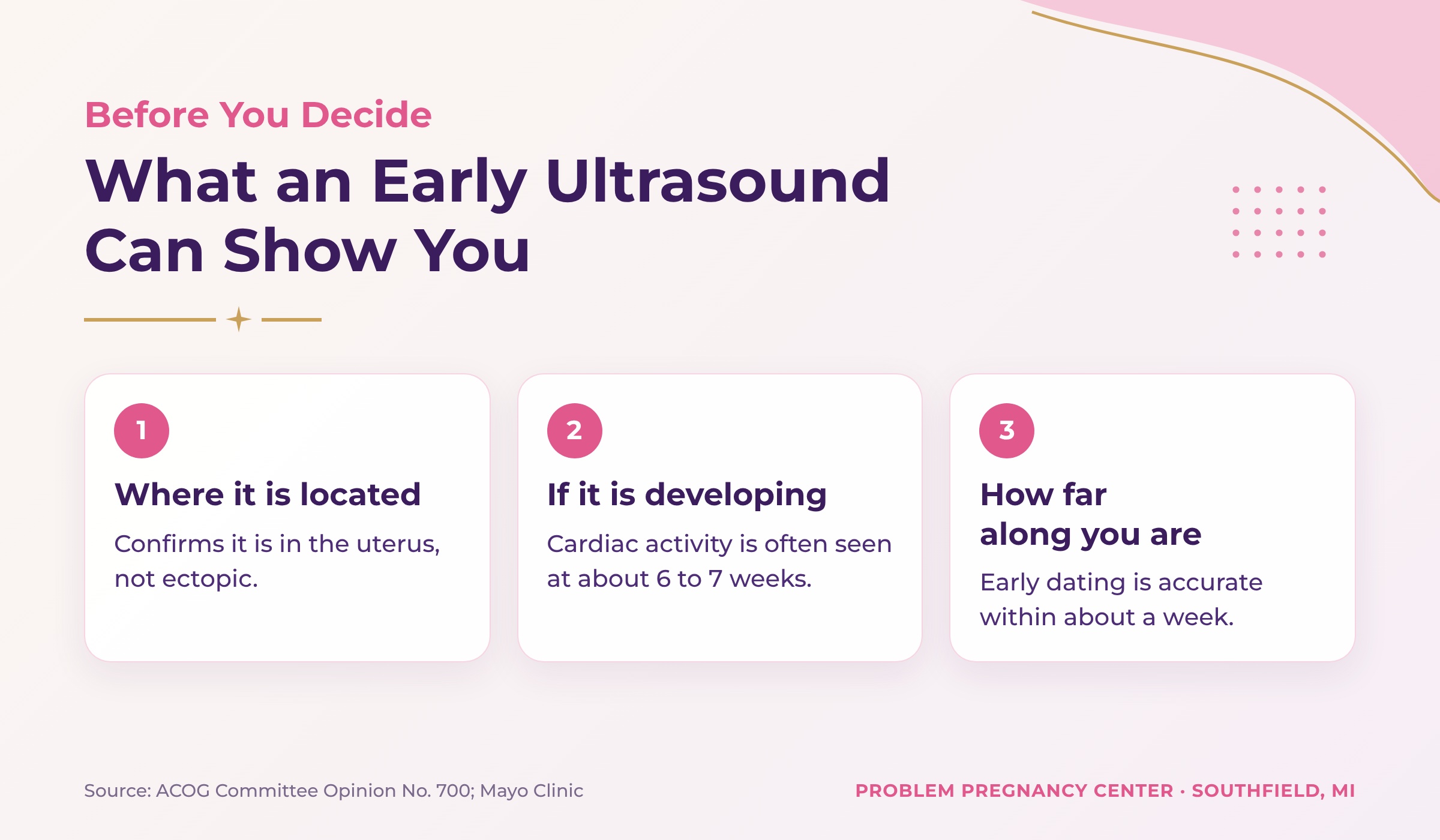
A positive home pregnancy test tells you that your body is producing hCG, the pregnancy hormone. It cannot tell you where the pregnancy is, how far along it is, or whether it is developing. An ultrasound answers those questions in a way no other test can.
Here is what an early ultrasound can help confirm:
- That the pregnancy is in the uterus. A pregnancy that implants outside the uterus, called an ectopic pregnancy, cannot continue and can be dangerous. According to the Mayo Clinic, a transvaginal ultrasound is how doctors see the exact location of a pregnancy.
- How far along you are. The American College of Obstetricians and Gynecologists (ACOG) says a first-trimester ultrasound measurement is the most accurate way to establish or confirm how far along a pregnancy is, with an accuracy of about 5 to 7 days (ACOG Committee Opinion No. 700).
- Whether there is cardiac activity. Early in pregnancy, this is one of the main signs that a pregnancy is developing.
Each of these facts matters no matter what you are thinking about doing next. Many women are also surprised to learn that the dates they count from their last period can be off by a week or more. An ultrasound gives you accurate information to make your decisions with.
If you are considering the abortion pill: the FDA approves mifepristone with misoprostol to end a pregnancy in the uterus through 10 weeks (70 days since the first day of your last period). The FDA also lists a confirmed or suspected ectopic pregnancy as a reason the regimen should not be used (FDA). Knowing how far along you are and where the pregnancy is located is important information to have first.
How much does an ultrasound cost without insurance?
Prices vary widely depending on the type of ultrasound, the facility and your location. GoodRx, which compiles self-pay price data, reports that an ultrasound generally costs between $200 and $1,000 without insurance (GoodRx).
| Type of ultrasound | Typical self-pay price (national average) |
|---|---|
| Ultrasound in general | $200 to $1,000 |
| Routine fetal (pregnancy) ultrasound | About $459 |
| Transvaginal ultrasound with pelvic exam | About $594 |
| Specialized fetal ultrasound | About $954 |
Source: GoodRx, citing MDsave national averages. Actual prices depend on the facility.
When you compare where to get an ultrasound without insurance, keep in mind that hospital-based imaging is usually the most expensive option. Outpatient imaging centers and clinics often charge less, and many offer a self-pay discount if you ask before your appointment.
Where to get an ultrasound without insurance for less
- Call two or three places and ask for the self-pay or cash price before you book.
- Ask whether they offer a payment plan or a discount for paying the same day.
- Choose an outpatient facility over a hospital when it is medically appropriate.
- Check whether you qualify for Medicaid. Michigan Medicaid covers pregnancy-related care for many women who qualify, and you can apply online through MI Bridges.
- Look for nonprofit pregnancy centers that offer a free limited ultrasound to women who qualify.
Where to get an ultrasound without insurance
If you are looking for where to get an ultrasound without insurance, these are the main types of places to consider. Each one serves a slightly different purpose, which is why it helps to know what you need before you call.
Community health centers
Federally funded community health centers serve patients regardless of insurance and often charge on a sliding scale based on income. Many provide prenatal care and can order an ultrasound or provide one on site.
Outpatient imaging centers
Independent imaging centers usually require an order from a doctor or other licensed provider. Their self-pay prices are often lower than a hospital’s, and they can be a good choice if you already have a provider.
Your own doctor or a women’s health clinic
An OB-GYN or women’s health clinic can provide a full pregnancy exam along with an ultrasound. If you plan to continue a pregnancy, this is where ongoing prenatal care happens.
Nonprofit pregnancy centers: where to get an ultrasound without insurance for free
Some nonprofit pregnancy centers offer a free limited ultrasound performed by licensed personnel. These ultrasounds are focused on a few early pregnancy questions rather than a full medical exam. At Problem Pregnancy Center, a free limited ultrasound is available to women who have a positive pregnancy test, are about six weeks along or more, and meet our other criteria.
Hospital emergency rooms
An emergency room is not the place for a routine early ultrasound, and it is usually the most expensive. It is the right place if you have warning signs (see below).
Get medical care right away if you have heavy bleeding, severe pain in your belly or shoulder, dizziness, or fainting. Call 911 or go to the nearest emergency room. These can be signs of an ectopic pregnancy or another emergency.
What is a limited ultrasound, and what can it show?
A limited ultrasound is a focused exam that answers a specific question rather than examining everything. The American Institute of Ultrasound in Medicine describes a limited obstetric ultrasound as one done to answer a specific clinical question, and notes that it does not include a full anatomy evaluation (AIUM).
In early pregnancy, a limited ultrasound is commonly used to look at three things:
| Question | Why it matters |
|---|---|
| Is the pregnancy in the uterus? | A pregnancy outside the uterus needs medical care and cannot continue. |
| Is there cardiac activity? | Helps show whether the pregnancy is developing. |
| How far along is the pregnancy? | Affects which options are available and when. |
A limited ultrasound is not a diagnosis and it does not replace medical care. If anything unexpected shows up, you would be encouraged to follow up with a doctor. For many women deciding where to get an ultrasound without insurance, a free limited ultrasound is a practical first step.
Where to get an ultrasound without insurance, and when to go
Timing matters as much as knowing where to get an ultrasound without insurance. If an ultrasound is done too early, there may be nothing to see yet, which can be confusing and worrying. According to the Mayo Clinic, an ultrasound can usually confirm or rule out an ectopic pregnancy about five to six weeks after conception.
On a transvaginal ultrasound, the general sequence looks like this (Family Practice Notebook):
- About 5 weeks: a gestational sac may be visible.
- About 5 to 6 weeks: a yolk sac and early fetal pole may appear.
- About 6 to 7 weeks: cardiac activity is often seen.
These weeks are counted from the first day of your last period. If your cycles are irregular or you are unsure of your dates, an ultrasound may be scheduled a little later, or repeated, to get a clear answer. This is also why PPC offers free limited ultrasounds starting at about six weeks.
Where to get an ultrasound without insurance: how to prepare
A little preparation can save you money and stress, especially if you are paying out of pocket.
Before you book
- Write down the first day of your last period, even if you are unsure.
- Take a home pregnancy test, or get a free one, so you know it is positive.
- Ask the exact self-pay price and whether it includes the reading of the results.
- Ask whether you need an order from a provider first.
Questions to ask at your appointment
- Is the pregnancy in the uterus?
- About how many weeks along am I?
- Was cardiac activity seen?
- Do I need a follow-up ultrasound, and when?
- Who should I contact if I have bleeding or pain afterward?
What to bring
- A photo ID such as a driver’s license or state ID.
- Your period dates and any home test results.
- A list of questions, and someone you trust if you would like support.
If you would like to see exactly what happens during a visit with us, read what happens at your first appointment. You can also compare a free ultrasound vs. an at-home pregnancy test.
Where to get an ultrasound without insurance near Detroit
If you are in Southfield, Detroit, Oak Park, Royal Oak, Farmington Hills or nearby, and you have been searching for a cheap ultrasound near me, a free option may be closer than you think. Problem Pregnancy Center in Southfield offers free pregnancy tests and free limited ultrasounds for women who qualify, along with a private options consultation where you can talk through your situation without pressure or judgment.
Every visit includes a pregnancy test. If your test is positive and you are about six weeks along or more, you may qualify for a free limited ultrasound at that visit or at a follow-up appointment. Our services are confidential, and you do not need insurance.
Not sure how early an ultrasound can see a pregnancy? Our guide on how soon an ultrasound can detect pregnancy explains the timing in more detail, and our article on the signs of ectopic pregnancy explains which symptoms need urgent care.
Facing an unplanned pregnancy in Southfield?
You deserve clear answers before you make any decision. Start with a free pregnancy test and, if you qualify, a free limited ultrasound. No insurance needed, and everything is confidential.
Frequently asked questions
Where to get an ultrasound without insurance near me?
Community health centers, outpatient imaging centers and women’s health clinics often offer self-pay prices. Some nonprofit pregnancy centers offer a free limited ultrasound to women who qualify. In the Southfield and Detroit area, Problem Pregnancy Center offers one at no cost for eligible women.
How much is a pregnancy ultrasound without insurance?
National averages put a routine fetal ultrasound at about $459, and ultrasounds in general between $200 and $1,000, according to GoodRx. Prices depend on the facility. Ask for the self-pay price before you book.
How early can an ultrasound confirm a pregnancy?
A gestational sac may be visible around 5 weeks on a transvaginal ultrasound, and cardiac activity is often seen around 6 to 7 weeks, counted from the first day of your last period. Earlier than that, there may be nothing visible yet.
Is a free limited ultrasound the same as a full ultrasound?
No. A limited ultrasound is focused on a few early questions, such as where the pregnancy is located, whether there is cardiac activity and how far along it is. It does not replace prenatal care or a full medical exam.
Do I need an ultrasound before deciding what to do?
Many women find it helpful. An ultrasound can show whether the pregnancy is in the uterus, whether it is developing and how far along it is. That information can affect your options and your timing, whatever you decide.
Sources
- GoodRx: How Much Does an Ultrasound Cost Without Insurance?
- ACOG Committee Opinion No. 700: Methods for Estimating the Due Date
- Mayo Clinic: Ectopic pregnancy, diagnosis and treatment
- FDA: Questions and Answers on Mifepristone
- AIUM: Limited Obstetrical Ultrasound Examination
- Family Practice Notebook: First Trimester Ultrasound


