

When a period does not arrive on time, many women ask the same question first: can stress delay your period? The answer is yes, and there is clear science behind it. Still, stress is only one possible reason for a late period, and a pregnancy test is the only way to know whether pregnancy is part of the picture.
This guide explains how stress affects your hormones and ovulation, how late a period can be because of stress, and what else can cause a missed period. It also covers when a pregnancy test gives a reliable answer and when it is time to see a doctor. If you live in Southfield, Detroit or anywhere in Metro Detroit, you will also find where to get a free pregnancy test.
Quick answer
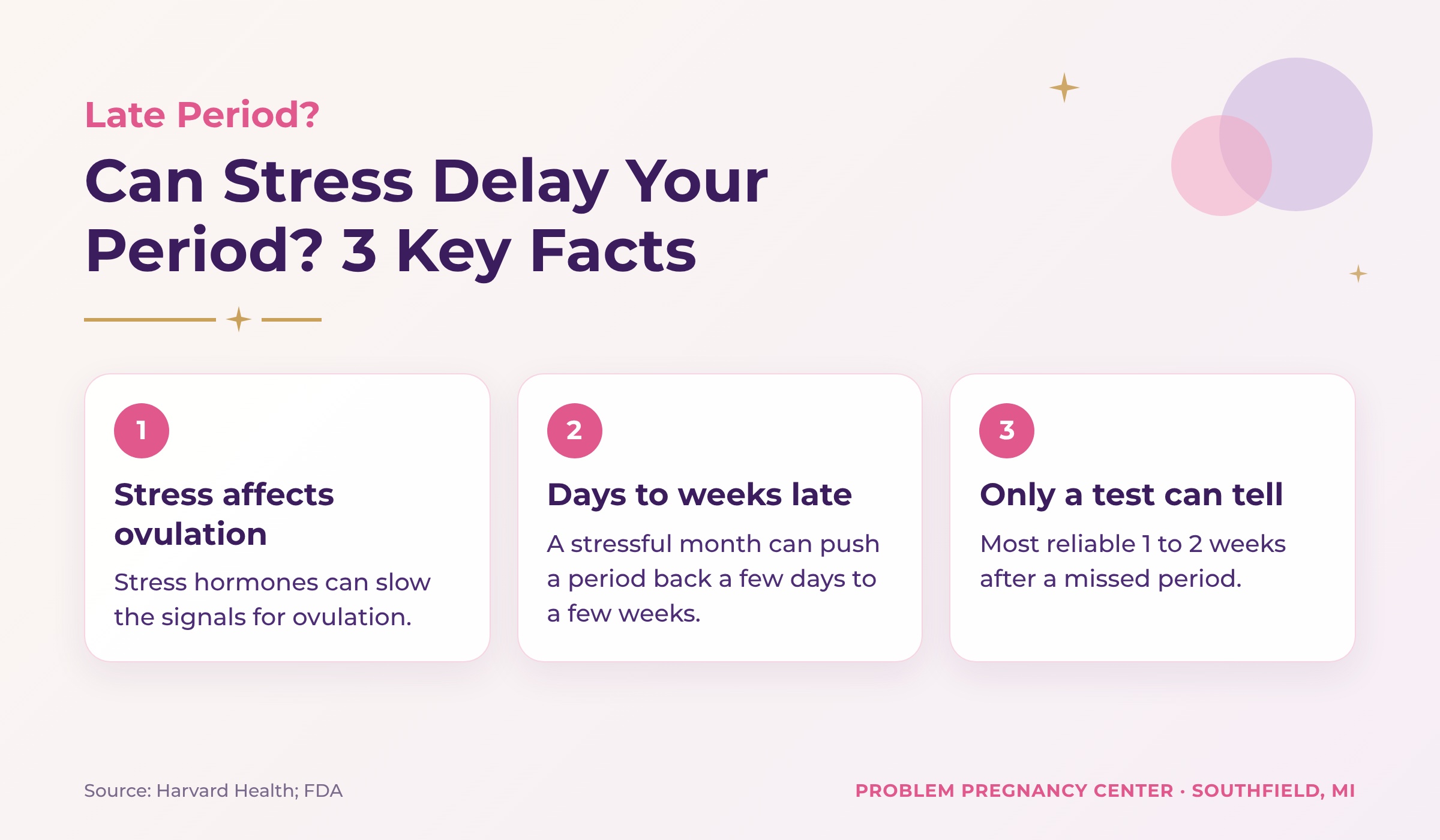
Stress can reduce the hormone signals from your brain that trigger ovulation, and that can push your period back by a few days to a few weeks (Harvard Health). Because pregnancy is also a common cause of a late period, taking a pregnancy test is the only way to rule it in or out. The FDA says results are most reliable 1 to 2 weeks after a missed period.
In this article
- Can stress delay your period? How it works in your body
- How late can stress delay your period?
- Can stress delay your period, or is it something else?
- Why worrying about pregnancy can add to the stress
- When a pregnancy test gives a reliable answer
- When to see a doctor
- What to do next: a simple checklist
- Free pregnancy test near Detroit
- Frequently asked questions
Can stress delay your period? How it works in your body
Your menstrual cycle runs on a chain of hormone signals. It starts in a small area of the brain called the hypothalamus, which sends signals to the pituitary gland. The pituitary gland then signals your ovaries, and your ovaries prepare an egg for release.
The hormone chain behind ovulation
The hypothalamus releases a hormone called GnRH (gonadotropin-releasing hormone) in regular pulses. Those pulses tell the pituitary gland to release two more hormones, LH (luteinizing hormone) and FSH (follicle-stimulating hormone). Together, LH and FSH help an egg mature and trigger ovulation.
Your period usually comes about two weeks after ovulation. In other words, the timing of your period depends on the timing of ovulation. When ovulation happens late, your period arrives late as well.
Why can stress delay your period?
When you are under stress, your body releases a hormone called CRH (corticotropin-releasing hormone), which leads to higher cortisol levels. A medical review in the Journal of Clinical Research in Pediatric Endocrinology explains that this rise in CRH suppresses the normal pulses of GnRH. As a result, LH and FSH levels drop, and the ovaries may not release an egg on schedule.
Doctors call the most severe form of this pattern functional hypothalamic amenorrhea. A review in the Journal of Endocrinological Investigation describes three main types: one related to stress, one related to weight loss and one related to exercise. Women with this condition often have mildly raised cortisol levels.
Most stress-related changes are milder and temporary. According to the Mayo Clinic, mental stress can temporarily affect the part of the brain that controls the hormones of your cycle. Periods usually return once the stress eases.
How late can stress delay your period?
There is no exact number of days that applies to every woman. Harvard Health notes that stress can delay a period by a few days to a few weeks, and the period may be heavier when it does arrive (Harvard Health). In some cases, ongoing stress can cause you to skip a period entirely.
Several things affect how much stress changes your cycle:
- Timing. Stress in the first half of your cycle, before ovulation, is more likely to delay your period than stress afterward.
- Intensity. A major life event, such as a loss, a move or a crisis at work or home, can have a larger effect than everyday pressure.
- Other factors. Poor sleep, eating less than usual or exercising harder can add to the effect of emotional stress.
An important point: stress can delay ovulation, but it does not reliably stop it. The same medical review notes that ovulation can still happen without warning, even when cycles are disrupted (JCRPE). This means a stressful month does not rule out pregnancy.
Can stress delay your period, or is it something else? 9 common causes
Stress is a common explanation, but it is far from the only one. Your cycle responds to many changes in your body and daily life. The table below lists common causes of a late period and what tends to help.
| Possible cause | How it can affect your period | What helps |
|---|---|---|
| Pregnancy | The most common reason for a missed period in women who are sexually active. | Take a pregnancy test, and repeat it if your period still does not come. |
| Stress | Lowers the brain signals that trigger ovulation. | Rest, regular sleep, support from people you trust and time. |
| Weight change or eating too little | Eating too few calories can suppress the hypothalamus. | Regular, balanced meals. Talk with a doctor about sudden weight loss. |
| Intense exercise | Rigorous training can stop periods, especially with low body fat. | Balance training with enough food and rest. |
| Recent illness | A fever or illness can shift the timing of ovulation. | Give your body time to recover. Your cycle often returns to normal. |
| Thyroid problems | An overactive or underactive thyroid can change your cycle. | A doctor can check your thyroid with a blood test. |
| PCOS | Hormone levels stay mostly the same instead of rising and falling, which can prevent ovulation. | A doctor can diagnose PCOS and discuss treatment. |
| Breastfeeding | An expected, natural reason for periods to pause. | No action needed, though ovulation can return before your first period. |
| Birth control changes | Some pills, the shot, the implant and hormonal IUDs can stop periods. Copper IUDs typically do not. | Ask your prescriber what to expect after starting, stopping or switching. |
Source: Mayo Clinic, Amenorrhea, and Harvard Health.
More than one factor can be at work at the same time. For example, a stressful season can also bring poor sleep, skipped meals and a cold. Each of these can play a part in a missed period.
Why worrying about pregnancy can add to the stress
If you keep asking yourself can stress delay your period, you are not imagining the connection. A late period can set off a difficult cycle of its own. You notice your period is late, and you begin to worry that you might be pregnant. That worry is a form of stress, and stress can delay your period even further.
Waiting without answers often makes this worse. Many women check for symptoms every hour, search online late at night or put off testing because they are afraid of the result. Each of those responses is understandable, and none of them means something is wrong with you.
Often, the most calming step is getting clear information. A test result, whether positive or negative, gives you something solid to work with. If anxiety about testing feels overwhelming, our article on pregnancy anxiety and taking a pregnancy test offers practical ways to cope.
Can stress delay your period past a test date? When results are reliable
Home pregnancy tests look for hCG, a hormone your body makes after a fertilized egg implants. According to the FDA, hCG can be detected about 12 to 15 days after ovulation in a 28-day cycle. Some tests can pick up pregnancy before a missed period, but early results are less certain.
Why timing matters when stress can delay your period
The FDA reports that 10 to 20 pregnant women out of every 100 will not detect their pregnancy on the first day of their missed period. For the most reliable result, the FDA advises testing 1 to 2 weeks after you miss your period. Using your first urine of the morning may also help, because it usually contains more hCG.
Stress adds one more layer. If stress delayed your ovulation, you may have ovulated later than you think. In that case, a test taken on the day you expected your period could be too early to show a positive result.
If your test is negative but your period has not come
The FDA notes that a negative result does not rule out pregnancy. If you still suspect pregnancy, you can test again after several days. You can learn more in our guides to a false negative pregnancy test and to having a missed period but a negative test.
No matter how likely stress seems, the only way to know whether you are pregnant is to take a test. Stress and pregnancy can also happen together. A test gives you a clear starting point for whatever comes next.
When to see a doctor
Even when you know stress can delay your period, some patterns deserve a closer look. An occasional late period is common, and it usually settles on its own. However, some situations call for a visit to a doctor or women’s health clinic. The Mayo Clinic advises seeing a doctor if you have missed at least three periods in a row (Mayo Clinic).
You may also want to make an appointment if:
- Your periods have become irregular for several months.
- You have lost or gained a large amount of weight without trying.
- You notice new symptoms such as hair growth, acne, hair loss or a racing heart.
- You have a positive pregnancy test and want to confirm the pregnancy.
Get medical care right away if you have heavy bleeding, severe pain in your belly or pelvis, pain in your shoulder, dizziness or fainting. Call 911 or go to the nearest emergency room. These signs can point to a serious problem, including a pregnancy outside the uterus.
What to do next: a simple checklist
Can stress delay your period this month? Possibly. Either way, a short list can make the next few days feel more manageable. Here are steps many women find helpful:
- Write down your dates. Note the first day of your last period and any days you had sex since then.
- Take a pregnancy test. Use first-morning urine and follow the instructions carefully.
- Retest if needed. If the test is negative and your period still has not come, test again in several days.
- Look at the bigger picture. Think about recent stress, sleep, illness, weight changes, exercise or new medication.
- Care for yourself. Regular meals, rest and time with people you trust can help your body settle.
- Know your warning signs. Seek medical care right away for heavy bleeding, severe pain or fainting.
- Reach out if you want support. A private conversation can help you sort through your questions without pressure.
Free pregnancy test near Detroit
If you live in Southfield, Detroit or a nearby community and your period is late, you do not have to wait and wonder alone. Problem Pregnancy Center in Southfield offers a free pregnancy test in a calm, private setting. Our services are confidential, and you do not need insurance.
If your test is positive and you are about six weeks along or more, you may qualify for a free limited ultrasound. We also offer an options consultation, which is a private conversation where you can ask questions and talk through your situation. We will not pressure you, and you are free to take whatever time you need.
Wondering what a visit looks like? Read what happens at your first appointment for a step-by-step overview. Women from across Metro Detroit visit us for clear, judgment-free answers.
Facing an unplanned pregnancy in Southfield?
A late period can bring a lot of uncertainty. If you would like a clear answer, start with a free pregnancy test and a private conversation about your questions. No insurance needed, and everything is confidential.
Frequently asked questions
Can stress delay your period by a week or more?
Yes. Stress can reduce the brain signals that trigger ovulation, and Harvard Health notes that this can delay a period by a few days to a few weeks. Because pregnancy can also cause a late period, a pregnancy test is the only way to know for sure.
Can stress make you miss a period completely?
It can. Ongoing or severe stress can lower GnRH, LH and FSH enough that ovulation does not happen, and a period may be skipped. The Mayo Clinic advises seeing a doctor if you miss three or more periods in a row.
When should I take a pregnancy test if my period is late?
Some tests can detect pregnancy early, but the FDA says results are most reliable 1 to 2 weeks after a missed period. If your first test is negative and your period still has not come, test again after several days.
Does stress affect a pregnancy test result?
Stress does not change how a test reads hCG. However, stress can delay ovulation, which means you may test earlier in a possible pregnancy than you realize. Testing again a few days later can give a clearer answer.
Where can I get a free pregnancy test near Detroit?
Problem Pregnancy Center in Southfield offers free, confidential pregnancy tests, and no insurance is needed. Women who qualify can also receive a free limited ultrasound and a private options consultation.
Sources
- Harvard Health Publishing: How does stress affect your period?
- Mayo Clinic: Amenorrhea, symptoms and causes
- U.S. Food and Drug Administration: Pregnancy (home use tests)
- Journal of Clinical Research in Pediatric Endocrinology: Where Have the Periods Gone? The Evaluation and Management of Functional Hypothalamic Amenorrhea
- Journal of Endocrinological Investigation (PubMed): Functional hypothalamic amenorrhea and its influence on women’s health


