

A positive pregnancy test followed by a period a few days later, or by a negative result on a second test, can be difficult to interpret. A chemical pregnancy is one of the most common explanations for results like these.
This guide explains what a chemical pregnancy is, how often it occurs, the signs to watch for and how it differs from a regular period, along with when to contact a doctor. For women in Detroit, Southfield and across Metro Detroit who are unsure whether an unplanned pregnancy is continuing, we can help confirm where things stand privately and at no cost.
Quick answer: A chemical pregnancy is a very early pregnancy loss that occurs soon after implantation, within the first five weeks and before an ultrasound can detect a pregnancy. It often resembles a late or heavier period after a positive test and is most often linked to a problem with the embryo’s development.
What is a chemical pregnancy?
A chemical pregnancy is a very early miscarriage. According to Cleveland Clinic, it occurs within the first five weeks of pregnancy, before a pregnancy is visible on an ultrasound, and doctors also refer to it as a biochemical pregnancy.
The name reflects how it is detected. After a fertilized egg implants in the uterus, it begins producing hCG, the hormone a pregnancy test measures. Because that hormone is the only evidence of the pregnancy, it is described as “chemical” rather than “clinical.”
In this type of loss, the embryo usually stops developing within a few days of implantation. hCG levels then fall, and the body passes the tissue, often around the time a period is expected.
How common is a very early miscarriage?
Early pregnancy loss is more common than many women realize. Cleveland Clinic reports that about 25% of all pregnancies end within the first 20 weeks, and about 80% of those losses occur early.
MedlinePlus, from the National Library of Medicine, notes that around half of all fertilized eggs are lost spontaneously, usually before a woman knows she is pregnant, and that about 10% to 25% of women who know they are pregnant experience a miscarriage.
Because home tests can detect a pregnancy very early, more women now see a positive result before a chemical pregnancy occurs, which can make the sequence of results harder to understand.
What are the signs of a chemical pregnancy?
Some women notice nothing beyond a positive test that does not last. Cleveland Clinic lists the following common signs:
- A positive pregnancy test followed by a period
- A positive test that later turns negative
- A period that arrives about a week late
- Bleeding that is heavier than usual, sometimes with clots
- Cramping that is stronger than typical menstrual cramps
- A positive test without typical early pregnancy symptoms
Bleeding may begin as spotting and then become heavier. Cleveland Clinic notes that tissue may pass over several days or a few weeks, and some women bleed for a week or longer.
If the first sign was a light second line on a home test, our article on a faint positive pregnancy test explains what a faint line can and cannot indicate.
Chemical pregnancy vs. period: how can you tell?
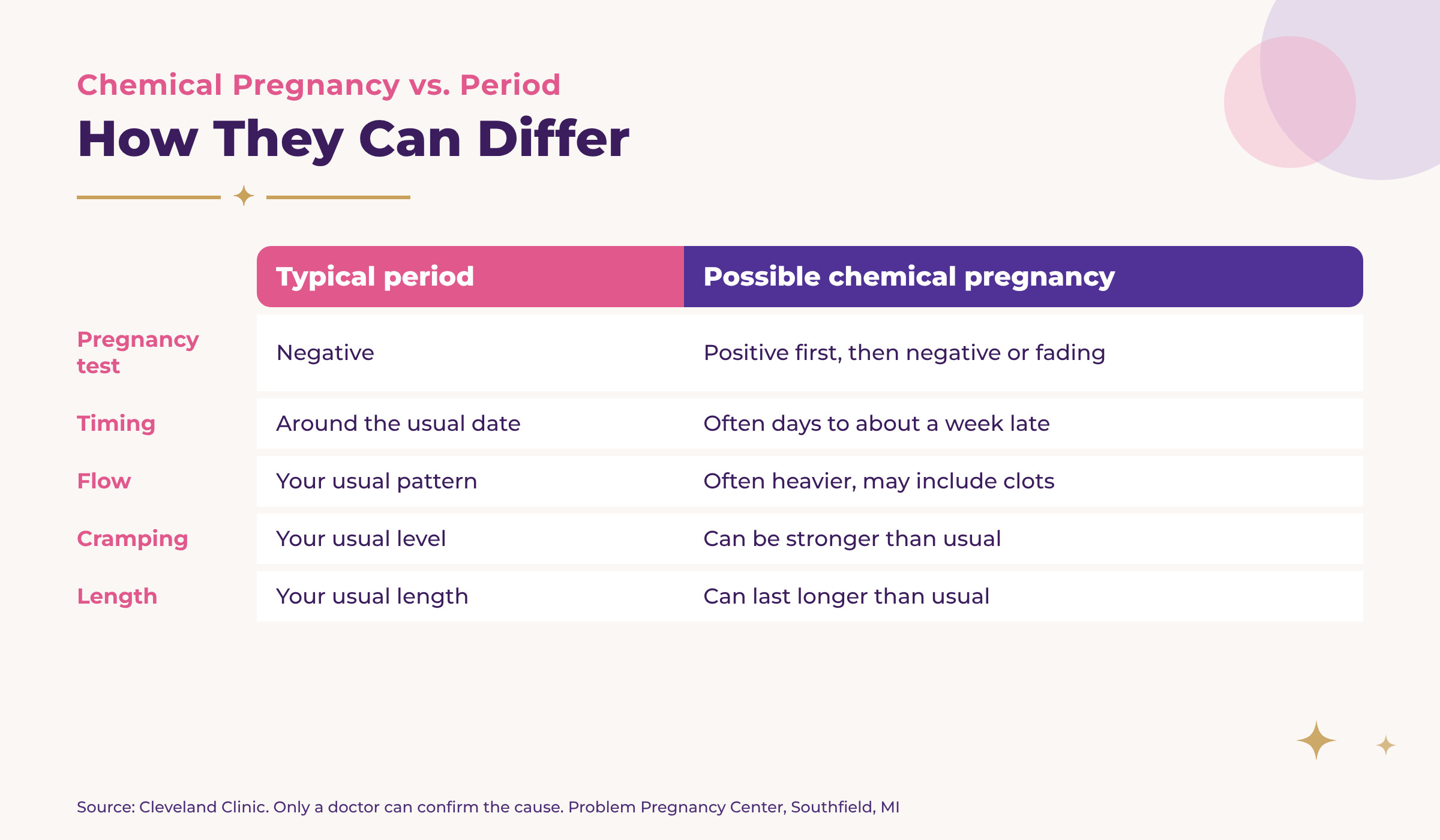
Because this type of loss often occurs close to the expected date of a period, it is frequently mistaken for a normal cycle. Timing, flow and test results provide the main clues.
| Typical period | Possible chemical pregnancy | |
|---|---|---|
| Pregnancy test | Negative | Positive first, then negative or fading |
| Timing | Around the usual date | Often several days to about a week late |
| Flow | Usual pattern | Often heavier, may include clots |
| Cramping | Usual level | Can be stronger than usual |
| Duration | Usual length | Can last longer than usual |
No home method can confirm a chemical pregnancy with certainty. A doctor can use repeat hCG blood tests to see whether levels are rising or falling, and Cleveland Clinic notes that hCG levels fall by about 50% every two days on average afterward, which means a home test can remain positive for some time.
What causes a chemical pregnancy?
In most cases, the exact cause is unknown. Cleveland Clinic explains that the embryo likely stops developing because of a problem with its genetic makeup, and in some cases it does not implant properly in the uterine lining.
Cleveland Clinic also lists several factors associated with a higher risk:
- Being 35 or older
- An irregularly shaped uterus
- Hormone levels that are too high or too low
- Certain untreated infections
- Thyroid disorders, diabetes or polycystic ovary syndrome (PCOS)
If your results seem to contradict each other and this pregnancy was not planned, our Southfield center offers confidential pregnancy confirmation at no cost. You can request an appointment online.
How is it confirmed, and is there treatment?
A doctor may confirm an early miscarriage by reviewing the date of the last menstrual period and ordering hCG blood tests a few days apart to see whether levels are falling. An ultrasound may also be used to confirm that no pregnancy is developing.
According to Cleveland Clinic, no treatment is needed for a chemical pregnancy because the body usually passes the tissue on its own. MedlinePlus notes that, in rare cases, an ectopic pregnancy can resemble a miscarriage, which is one reason follow-up care is important.
Is the pregnancy continuing?
Mixed results leave many women uncertain whether they are still pregnant. When a pregnancy is unplanned, every option depends on first knowing whether it is continuing and how far along it is.
| Question | Why it matters | How we can help |
|---|---|---|
| Am I still pregnant? | A fading line can reflect a loss or an early test | Pregnancy confirmation |
| How far along am I? | Your options depend on how many weeks along you are | Limited ultrasound |
| What are my options? | Accurate information supports an informed decision | Private options consultation |
When should you get medical care?
Certain symptoms should be checked by a doctor promptly, and some require emergency care because they can signal heavy blood loss, infection or an ectopic pregnancy.
| Contact a doctor soon | Get emergency care now |
|---|---|
| A positive test followed by bleeding | Bleeding that soaks through pads or does not stop |
| A test that stays positive for weeks | Severe abdominal or pelvic pain, especially on one side |
| Bleeding that lasts longer than expected | Shoulder pain, fainting or extreme lightheadedness |
| More than one early loss | Fever, chills or foul-smelling discharge |
Mayo Clinic advises emergency help for severe abdominal or pelvic pain with vaginal bleeding, extreme lightheadedness or fainting, and shoulder pain. MedlinePlus adds that fever, bleeding that does not stop and foul-smelling discharge can be signs of infection that need immediate attention.
If you experience any of these symptoms, call 911 or go to the nearest emergency room right away.
What to do next
If you think a chemical pregnancy may have occurred, the following steps can help you reach a clear answer:
- Record the dates. Note the first day of your last period, the date of your positive test and when bleeding began.
- Retest if you are unsure. A test taken a few days after bleeding begins can show whether hCG is falling.
- Monitor your symptoms. Use the table above to recognize when to call a doctor or seek emergency care.
- Plan follow-up care. Ask a doctor whether a follow-up blood test or visit is appropriate.
- Confirm where things stand. If the pregnancy was unplanned, a confidential appointment, including a limited ultrasound for women who qualify, can show whether it is continuing.
- Take care of your emotional health. Our article on emotional health during an unplanned pregnancy offers practical guidance.
A pregnancy center near Detroit and Southfield
Problem Pregnancy Center is located in Southfield, MI, and serves women from Detroit, Oak Park, Royal Oak, Farmington Hills, Dearborn, Livonia and the surrounding areas of Oakland, Wayne and Macomb counties.
For women facing an unplanned pregnancy, our services are free, confidential and require no insurance. They include pregnancy confirmation, a limited ultrasound for those who qualify and a private options consultation.
Learn more about pregnancy testing in Southfield or review all of our pregnancy services.
Facing an unplanned pregnancy in Southfield?
After a positive test, a late period or results that do not match, accurate information is the most useful next step. If this pregnancy was not planned, we can help you confirm whether it is continuing and, if you qualify, provide a limited ultrasound to show how far along you are.
Our services are free and confidential, with no insurance required, and you will have a private place to get clear answers and talk through your options.
Frequently asked questions
What is a chemical pregnancy?
A chemical pregnancy is a very early miscarriage that occurs within the first five weeks, before an ultrasound can detect a pregnancy. A pregnancy test detects hCG, and the pregnancy stops developing shortly after implantation.
What is the difference between a chemical pregnancy vs period?
A chemical pregnancy usually follows a positive test and may arrive late, be heavier or involve stronger cramping, while a regular period follows a negative test and matches the usual pattern. A doctor can confirm the cause with repeat hCG blood tests.
Is a chemical pregnancy the same as an early miscarriage?
A chemical pregnancy is a type of early miscarriage that occurs before a pregnancy can be seen on an ultrasound. It is very common, and the exact cause is usually unknown.
How long does bleeding last after a very early loss?
Bleeding varies from woman to woman. Cleveland Clinic notes that tissue may pass over several days or a few weeks, and some women bleed for a week or longer. Bleeding that soaks through pads, severe pain or fever requires emergency care.
Where can I find out if I am still pregnant near Detroit?
For women facing an unplanned pregnancy, Problem Pregnancy Center in Southfield, MI offers confidential pregnancy confirmation at no cost, along with a limited ultrasound for those who qualify. You can request an appointment online or call (734) 521-4441.
Sources
- Cleveland Clinic. Chemical Pregnancy.
- Cleveland Clinic. Human Chorionic Gonadotropin (hCG).
- MedlinePlus, U.S. National Library of Medicine. Miscarriage.
- Mayo Clinic. Ectopic Pregnancy: Symptoms and Causes.
- Cleveland Clinic. Pregnancy Tests: When to Take, Types and Accuracy.


