
Sore breasts, cramps, a short temper and a strong need for a nap can all show up in the days before your period is due. They can also be some of the first early pregnancy symptoms. If you are comparing PMS vs pregnancy symptoms and trying to make sense of what your body is telling you, you are far from alone.
This guide lays the two side by side, explains why they feel alike, and points out the few signs that may lean one way or the other. It also covers when a pregnancy test gives an accurate result and where women in Southfield, Detroit and across Metro Detroit can get a free test.
Quick answer
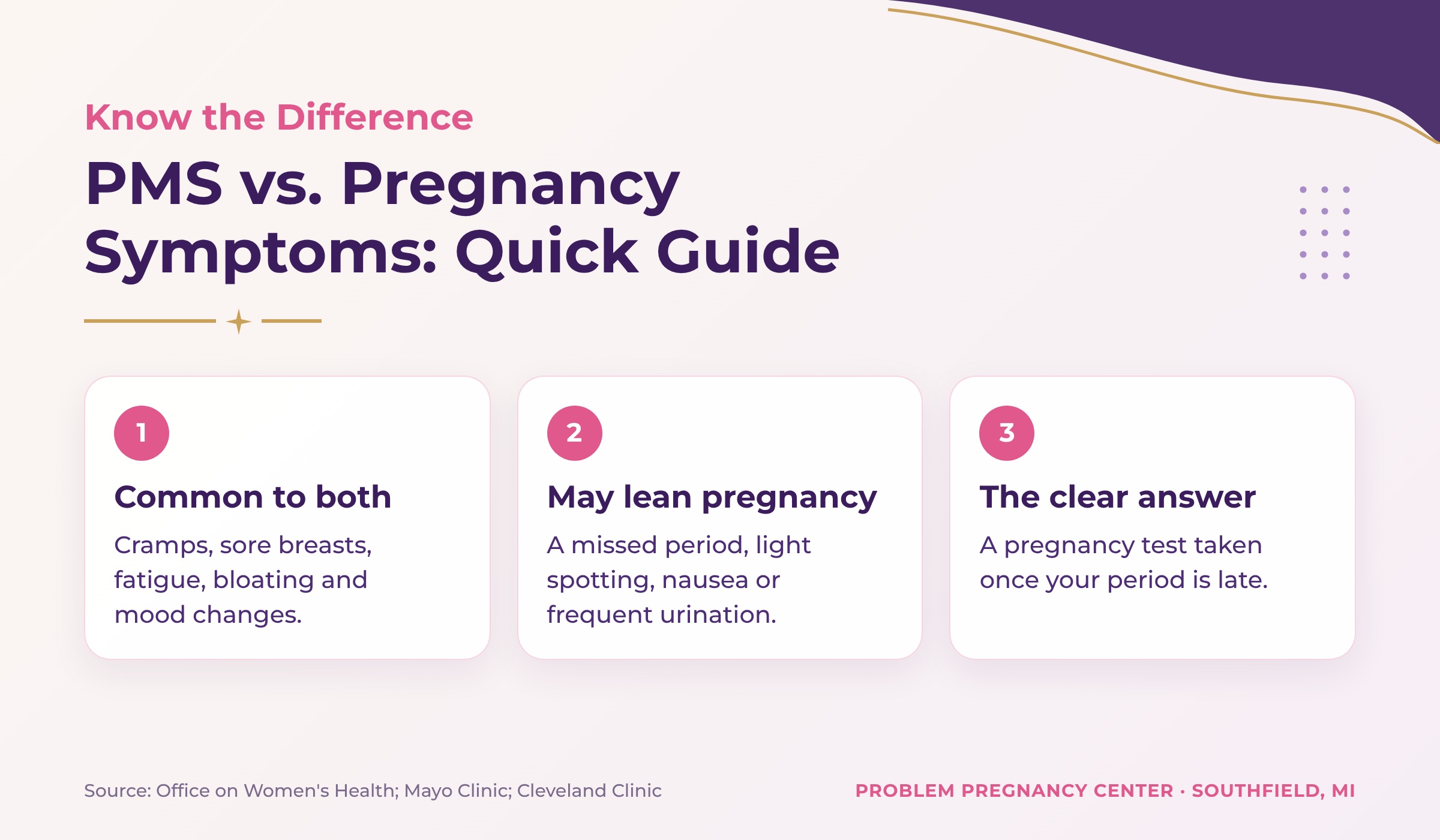
PMS and early pregnancy share many of the same symptoms, including cramping, breast tenderness, fatigue, bloating and mood changes. A few signs, such as light pink or brown spotting, nausea or a missed period, may point toward pregnancy. Symptoms alone cannot tell you for sure, and a pregnancy test taken after your period is late is the only reliable way to know.
In this article
- PMS vs pregnancy symptoms: why they feel alike
- PMS vs pregnancy symptoms: a side-by-side comparison
- Signs that may lean toward pregnancy
- PMS vs pregnancy symptoms: why only a test can answer
- Sorting out PMS vs pregnancy symptoms: when to test
- What to do next
- When to get medical care
- Free pregnancy test near Detroit
- Frequently asked questions
PMS vs pregnancy symptoms: why they feel alike
The overlap comes down to hormones, and one hormone in particular. After you ovulate, the empty egg follicle forms a structure called the corpus luteum, which begins producing progesterone. Progesterone thickens the lining of the uterus to prepare for a possible pregnancy (Cleveland Clinic).
What happens next depends on whether you are pregnant. If you are not, the corpus luteum breaks down, progesterone falls and your period starts. If you are, the corpus luteum keeps making progesterone, and levels continue to rise.
In both cases, your body spends the same week or two under the influence of the same hormones. As a result, the symptoms often look and feel nearly identical. The Office on Women’s Health notes that PMS likely happens because estrogen and progesterone levels begin falling sharply when a woman is not pregnant (womenshealth.gov).
PMS is also very common. More than 90% of women say they get some premenstrual symptoms, according to the Office on Women’s Health. Symptoms typically start about a week or two before a period and ease within a few days after it begins.
PMS vs pregnancy symptoms: a side-by-side comparison
The table below compares common symptoms. Keep in mind that every body is different, and the same woman can have different symptoms from one month to the next.
| Symptom | With PMS | In early pregnancy |
|---|---|---|
| Cramping | Common in the days before a period. Usually eases once bleeding starts. | Mild uterine cramping can happen early in pregnancy, often without a period following. |
| Breast tenderness | Swelling or soreness that tends to fade once the period begins. | Tender, swollen breasts are common. Soreness often decreases after a few weeks as hormones settle. |
| Mood changes | Irritability, mood swings, anxiety, low mood or crying spells. | Moodiness from hormone changes is common in early pregnancy. |
| Fatigue | Tiredness and sleep changes are listed PMS symptoms. | Fatigue is common in the first trimester and is linked to a rapid rise in progesterone. |
| Bloating | Bloating or gas is one of the most common PMS symptoms. | Hormone changes in early pregnancy can also cause bloating. |
| Spotting or bleeding | A normal period follows, with typical flow for you. | About 1 in 4 pregnant women have implantation bleeding: light pink or brown spotting that does not soak a pad. |
| Nausea | Not a typical PMS symptom. | Morning sickness often begins one to two months after becoming pregnant. Some women never have it. |
| Food cravings or aversions | Appetite changes and food cravings are common. | Food aversions, or a sudden dislike of certain foods or smells, can be an early sign. |
| Frequent urination | Not a typical PMS symptom. | Needing to urinate more often is a common early pregnancy symptom. |
| Timing | Starts about one to two weeks before a period and ends within a few days after it starts. | Can start around the time a period is due and continues when no period comes. |
Sources: Office on Women’s Health, Mayo Clinic, Cleveland Clinic and MedlinePlus. See the full list at the end of this article.
If you look closely at the table, most rows say nearly the same thing in both columns. That is the honest answer to the PMS or pregnancy question: for most women, the symptoms do not reliably separate the two. For a closer look at the pregnancy side, see our guide to the early signs of pregnancy.
PMS vs pregnancy symptoms: signs that may lean toward pregnancy
While most symptoms overlap, a few are less typical of PMS. None of these signs confirms a pregnancy on its own. However, they may be worth paying attention to.
A missed period
A missed period is often the first sign of pregnancy, according to the Office on Women’s Health. The Mayo Clinic describes it as a week or more passing without an expected period. Still, a late period has other possible causes, and a common question is can stress delay your period.
Light spotting instead of a period
Implantation bleeding usually happens about 10 to 14 days after ovulation, close to when a period would be expected (Cleveland Clinic). It tends to be pink, brown or dark brown, much lighter than a period, and should stop on its own within about two days. Bright or dark red blood that is heavy or contains clots is usually not implantation bleeding.
Nausea
Nausea is not a typical PMS symptom. In pregnancy, the Mayo Clinic notes that morning sickness often begins one to two months after conception, though some women feel it sooner (Mayo Clinic). Because it often starts later, nausea before a missed period is less common.
Frequent urination and food aversions
Needing to urinate more often and suddenly disliking foods you usually enjoy are both listed as early pregnancy symptoms. Neither appears on standard PMS symptom lists. Both can also have other causes.
When PMS vs pregnancy symptoms keep going
PMS symptoms usually ease within a few days after a period begins. If your period does not come and symptoms continue, that pattern is worth noting. It is a reason to take a test, not a final answer.
PMS vs pregnancy symptoms: why only a test can answer
Comparing symptoms can help you understand your body. However, it cannot tell you whether you are pregnant. Some pregnant women have no symptoms early on, and some women with strong PMS feel every sign on the list.
A pregnancy test looks for hCG, a hormone your body makes only when you are pregnant. According to the Cleveland Clinic, hCG starts building after a fertilized egg implants in the uterus, about six to 10 days after conception. Home tests are about 99% accurate when used correctly.
That accuracy depends on timing. The main cause of a false negative result is testing too early, before enough hCG has built up. Our article on the false negative pregnancy test explains other reasons a test may read negative.
Sorting out PMS vs pregnancy symptoms: when to test
It is natural to want an answer right away. Testing at the right time can save you from a confusing result and a second round of waiting.
- Wait until your period is late. MedlinePlus explains that home tests usually will not detect a pregnancy until your period is late, and testing before then will often give an inaccurate result (MedlinePlus).
- Consider waiting a week after a missed period. The Office on Women’s Health says waiting one week after a missed period will usually give a more accurate result, and notes that many pregnant women get negative results in the first few days after a missed period.
- Use first morning urine. Urine is most concentrated first thing in the morning. At other times, Cleveland Clinic suggests waiting at least three hours since you last urinated.
- Follow the directions exactly. Read the result in the time frame listed on the box. If the control line does not appear, the test is not working.
- Repeat a negative test. If your test is negative and your period still does not come, the Office on Women’s Health suggests testing again after a week.
About early result tests: some home tests can show a positive result as early as 10 days after conception, according to the Cleveland Clinic. A missed period usually happens around 14 days after conception, which is why waiting until then gives a more reliable result.
What to do next
Whether you are hoping for one answer or the other, it can help to have a simple plan. Here is a checklist many women find useful.
- Write down the first day of your last period and the date your next one is due.
- Note your symptoms and the day each one started.
- Take a pregnancy test once your period is late, ideally with first morning urine.
- If the test is negative and your period still has not come, test again in about a week.
- If you get two negative tests and still think you may be pregnant, contact a doctor.
- If your test is positive, plan to confirm it and learn how far along you may be.
- Think about who you trust to talk with, and what questions you have.
If you are still sorting through your questions, our am I pregnant page walks through common concerns. You do not need to have anything figured out before you take the next step.
When to get medical care
Most PMS and early pregnancy symptoms are uncomfortable but not dangerous. Some symptoms, however, need prompt attention. The Mayo Clinic advises getting emergency help for any signs of an ectopic pregnancy, which is a pregnancy that grows outside the uterus (Mayo Clinic).
Get medical care right away if you have severe pain in your belly or pelvis with vaginal bleeding, extreme lightheadedness or fainting, or shoulder pain. Call 911 or go to the nearest emergency room. Heavy bleeding with clots also needs prompt medical attention.
It is also wise to see a doctor if PMS symptoms are severe enough to disrupt your daily life. According to the Cleveland Clinic, about 20% of people with PMS symptoms have symptoms that severe, and treatment can help.
Free pregnancy test near Detroit
If you live in Southfield, Detroit or anywhere in Metro Detroit and you are wondering whether it is PMS or pregnancy, a free and confidential pregnancy test can give you a clear answer. Problem Pregnancy Center in Southfield offers free pregnancy tests with no insurance needed. You can also have a private options consultation to talk through your situation without pressure or judgment.
If your test is positive and you are about six weeks along or more, you may qualify for a free limited ultrasound. An ultrasound can show where the pregnancy is located and about how far along it is. Both are important pieces of information, whatever you are thinking about next.
We are here to listen and to help you get accurate information. What you decide to do with it is always your choice.
Facing an unplanned pregnancy in Southfield?
Symptoms can leave you guessing. A free pregnancy test gives you a clear answer, and our private options consultation gives you space to think through what comes next. No insurance needed, and everything is confidential.
Frequently asked questions
How can I tell PMS vs pregnancy symptoms apart?
Most symptoms, such as cramping, breast tenderness, fatigue, bloating and mood changes, appear in both. A missed period, light pink or brown spotting, nausea or frequent urination may lean toward pregnancy. A pregnancy test taken after your period is late is the only reliable way to know.
Can early pregnancy symptoms start before a missed period?
Yes. The Office on Women’s Health says symptoms such as headache, fatigue and breast tenderness can occur even before a missed period. These same symptoms are also common with PMS.
What does implantation bleeding look like compared with a period?
Implantation bleeding is usually pink, brown or dark brown and much lighter than a period. It should not soak a pad and usually stops within about two days. Heavy, bright red bleeding or clots are usually not implantation bleeding.
How soon can I take a pregnancy test?
For the most accurate result, wait until your period is late. Waiting one week after a missed period usually gives an even more accurate result. Testing with first morning urine can also help.
Is nausea a sign of PMS or pregnancy?
Nausea is not a typical PMS symptom, though it can have many other causes. In pregnancy, morning sickness often begins one to two months after conception. Some pregnant women never have nausea at all.
Sources
- Office on Women’s Health: Premenstrual Syndrome (PMS)
- Office on Women’s Health: Knowing If You Are Pregnant
- Mayo Clinic: Symptoms of pregnancy, what happens first
- Mayo Clinic: Ectopic pregnancy, symptoms and causes
- Cleveland Clinic: Progesterone
- Cleveland Clinic: Implantation Bleeding
- Cleveland Clinic: Pregnancy Tests
- Cleveland Clinic: PMS (Premenstrual Syndrome)
- MedlinePlus: Pregnancy test
- MedlinePlus: Premenstrual syndrome


