

If you recently took Plan B, it is natural to have questions about what happens next. One of the most common is how long does Plan B stay in your system, along with how long side effects last and when your next period should come. This guide walks through each of those questions in plain terms, using information from the FDA and other trusted medical sources.
Whether you are waiting on your period, feeling unwell or simply want to understand your body, you deserve clear facts. We also explain when a pregnancy test makes sense and where women in Southfield, Detroit and across Metro Detroit can get one for free.
Quick answer
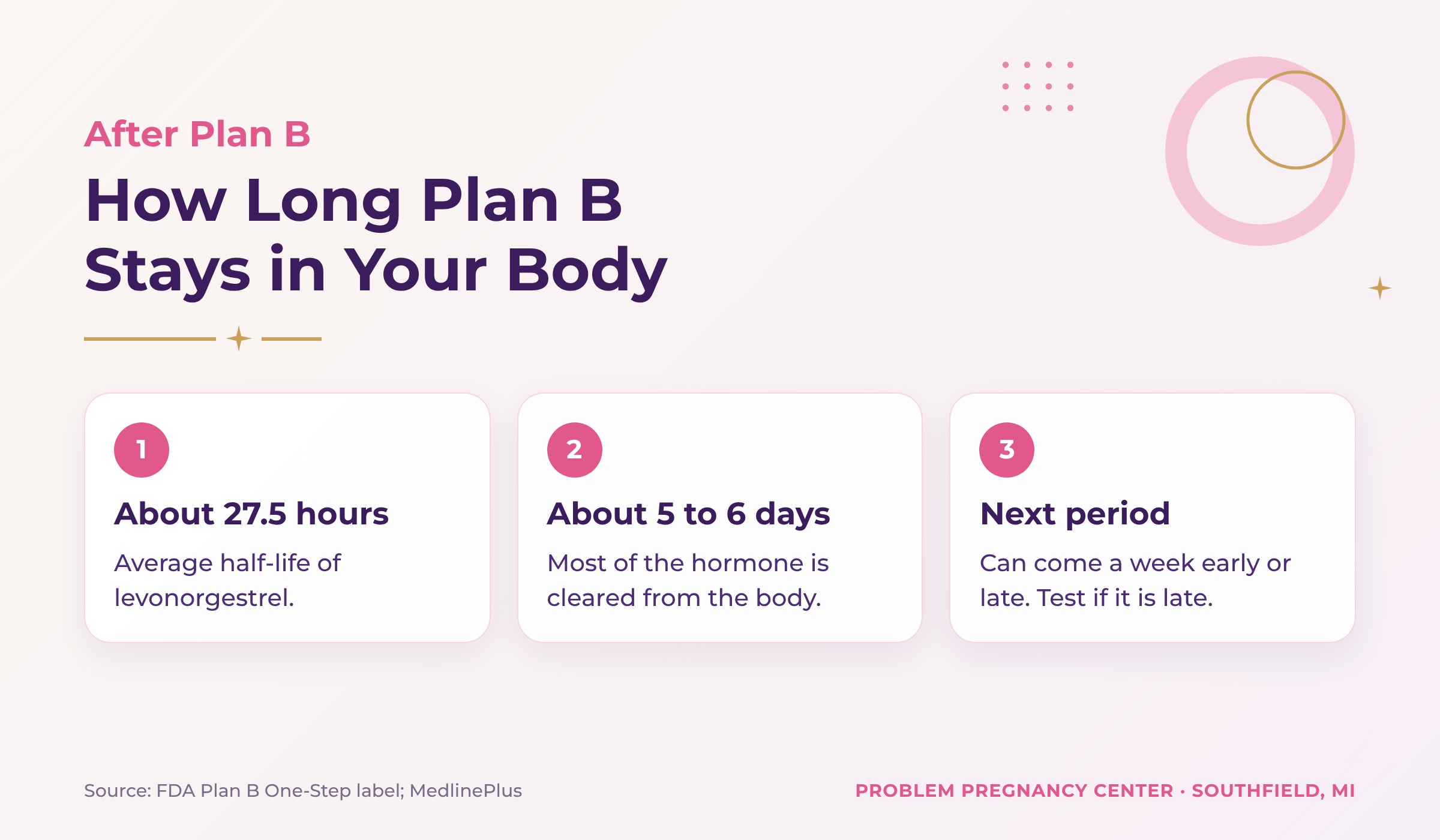
The hormone in Plan B, levonorgestrel, has an average half-life of about 27.5 hours, according to the FDA label. Most of it is cleared from the body within about five to six days. Side effects often last only a few days, and your next period may come up to a week earlier or later than expected.
In this article
- What is Plan B, and how does it work?
- How long does Plan B stay in your system?
- How long do Plan B side effects last?
- Your period after Plan B
- How long does Plan B stay in your system, day by day?
- Taking Plan B again in the same cycle
- When should you take a pregnancy test?
- When to get medical care
- What to do next: a checklist
- Free pregnancy test near Detroit
- Frequently asked questions
What is Plan B, and how does it work?
Plan B One-Step is an emergency contraceptive pill that contains 1.5 mg of levonorgestrel. Levonorgestrel is a man-made version of progestin, a hormone your body already makes. It is meant for occasional use after unprotected sex or a birth control failure.
According to the FDA, Plan B works before an egg is released from the ovary. It usually stops or delays ovulation. If no egg is released, sperm have nothing to fertilize.
The FDA also states that Plan B will not work if a person is already pregnant, and it does not end a pregnancy. In 2022, the FDA updated its consumer information to reflect that the evidence does not support an effect on fertilization or implantation. If you would like more detail on how well it works, read our guide on whether Plan B works.
How long does Plan B stay in your system?
To answer this question, it helps to understand the term half-life. A half-life is the time it takes for the amount of a drug in your body to drop by half. After each half-life, the amount left is cut in half again.
The FDA label for Plan B One-Step lists the average elimination half-life of levonorgestrel as about 27.5 hours. In other words, a little more than a day after taking it, about half of the hormone remains. A day later, about a quarter remains.
As a general rule, it takes about four to five half-lives for the body to clear most of a drug, according to GoodRx. For levonorgestrel, that works out to roughly five to six days. After that point, very little of the hormone is left in your body.
Good to know: clearing the hormone and feeling back to normal do not always happen on the same day. Your cycle may take a little longer to settle, which is why your next period can still be earlier or later than usual.
Does it build up or linger?
Plan B is a single dose, and the hormone does not stay in your body for weeks or months. Its effect on ovulation happens early. The FDA label also notes that Plan B is meant for emergency protection only and is not designed to be used frequently.
How long do Plan B side effects last?
Side effects are part of the answer to how long does Plan B stay in your system, because they usually fade as the hormone clears. Many women have no side effects at all. Others notice some changes in the first few days. In the FDA study used for the label, the most common reported effects were:
| Side effect | Share of women in the FDA study |
|---|---|
| Heavier menstrual bleeding | 30.9% |
| Nausea | 13.7% |
| Lower abdominal pain | 13.3% |
| Fatigue | 13.3% |
| Headache | 10.3% |
| Dizziness | 9.6% |
| Breast tenderness | 8.2% |
Source: FDA label for Plan B One-Step.
The good news is that Plan B side effects are usually short. The Mayo Clinic notes that side effects of the morning-after pill often last only a few days. MedlinePlus also lists vomiting, diarrhea and spotting between periods as possible effects.
Spotting and cramps
According to the FDA label, some women have spotting a few days after taking Plan B. Mild cramps can also happen. Spotting is not the same as a period, which is one reason it helps to keep track of the dates.
When side effects do not go away
MedlinePlus advises telling your doctor if any symptoms are severe or do not go away. Ongoing nausea, unusual pain or bleeding that worries you are all good reasons to check in with a healthcare provider.
Your period after Plan B
A change in timing is one of the most common questions about the period after Plan B, and it often follows the question of how long does Plan B stay in your system. Because the hormone can shift when you ovulate, it can also shift when your period arrives. This is expected and is usually temporary.
Here is what trusted sources say:
- Up to a week either way. MedlinePlus says it is normal for your next period to begin up to a week earlier or later than expected.
- Most periods come close to on time. In the FDA study, more than half of the women had their period within two days of the expected date (FDA label).
- A small share are later. The same study found that 4.5% of women had their period more than 7 days after the expected time.
- Bleeding may feel different. About 31% of women in the study noticed a change in their bleeding pattern, and the flow may be heavier or lighter than usual.
For a closer look at what is normal in the weeks that follow, read our article on what to expect after Plan B.
How long does Plan B stay in your system, day by day?
Every body is different, and this timeline is a general guide. It brings together what the FDA label, MedlinePlus and the Mayo Clinic describe.
| Time after taking Plan B | What may happen |
|---|---|
| First 24 hours | Nausea, headache, dizziness or tiredness may appear. About half of the hormone remains after roughly 27.5 hours. |
| First few days | Most side effects fade. Some women notice spotting or mild cramps. Most of the hormone is cleared within about five to six days. |
| Next period | Your period may come up to a week earlier or later than expected, and the flow may be heavier or lighter. |
| When to test | If your period is more than 7 days late, a pregnancy test is a good next step. The Mayo Clinic suggests testing if you have no period within three weeks of taking the pill. |
Taking Plan B again in the same cycle
Some women wonder what happens if they need emergency contraception more than once in a month, especially if they are unsure how long does Plan B stay in your system after the first dose. The FDA label describes Plan B as emergency protection only and notes that it is not designed to be used frequently. It also suggests talking with a healthcare professional if you find that you need it often.
Neither the FDA label nor MedlinePlus sets out a specific rule for a second dose in the same cycle. MedlinePlus says levonorgestrel should not be used to prevent pregnancy on a regular basis. Each dose is cleared on the same general timeline described above.
If you have questions about using it again, a pharmacist or healthcare provider can talk through what fits your situation.
When should you take a pregnancy test?
After Plan B, waiting for your period can feel long. A pregnancy test is the clearest way to know where things stand. Testing too early, however, may not give an accurate result.
The FDA label says that if your period is delayed beyond one week, you may be pregnant and should get a pregnancy test. MedlinePlus gives similar guidance. The Mayo Clinic also suggests taking a test if your period does not come within three weeks of taking the pill.
You may also want to test sooner if you have early pregnancy signs or if the spotting you had did not seem like a normal period. Our guide to Plan B and pregnancy tests explains timing in more detail.
When to get medical care
Most women have mild side effects or none at all. Still, whatever the answer to how long does Plan B stay in your system, a few symptoms need prompt attention. The FDA label advises seeking medical care for severe lower abdominal pain 3 to 5 weeks after taking Plan B, because it can be a sign of an ectopic pregnancy.
An ectopic pregnancy is one that grows outside the uterus, and it cannot continue. The Mayo Clinic also advises calling a healthcare professional for heavy bleeding with stomach pain, and warns that an untreated ectopic pregnancy can be life-threatening.
Get medical care right away if you have severe pain in your lower belly, heavy bleeding, dizziness or fainting. Call 911 or go to the nearest emergency room. These can be signs of an ectopic pregnancy or another emergency.
What to do next: a checklist
It can help to have a simple plan for the days and weeks ahead. Here is a checklist many women find useful:
- Write down the date you took Plan B and the date your period was expected.
- Note any side effects and when they begin and end.
- Track any spotting separately from your period.
- If your period is more than 7 days late, take a pregnancy test.
- If side effects are severe or do not go away, contact a healthcare provider.
- Seek urgent care for severe lower abdominal pain or heavy bleeding.
- If a test is positive, know that you have time to gather information before making any decision.
Free pregnancy test near Detroit
If you live in Southfield, Detroit, Oak Park, Royal Oak or anywhere nearby, you do not have to wait and wonder on your own. Problem Pregnancy Center in Southfield offers free pregnancy tests, and every visit is confidential. You do not need insurance.
If your test is positive and you are about six weeks along or more, you may qualify for a free limited ultrasound. We also offer a private options consultation, where you can talk through your situation without pressure or judgment. For more on local resources, see our article on Plan B in Detroit.
Facing an unplanned pregnancy in Southfield?
If your period is late after taking Plan B, you deserve a clear answer. Start with a free pregnancy test in a calm, private setting. No insurance needed, and everything is confidential.
Frequently asked questions
How long does Plan B stay in your system?
The hormone in Plan B, levonorgestrel, has an average half-life of about 27.5 hours, according to the FDA label. Most of it is cleared from the body within about five to six days. Its effect on ovulation happens early.
How long do Plan B side effects last?
Side effects of the morning-after pill often last only a few days, according to the Mayo Clinic. Common effects include nausea, headache, tiredness, cramps, breast tenderness and spotting. Contact a healthcare provider if symptoms are severe or do not go away.
How late can my period be after Plan B?
MedlinePlus says it is normal for your next period to come up to a week earlier or later than expected. If your period is more than 7 days late, the FDA label advises taking a pregnancy test.
Can Plan B end a pregnancy?
No. The FDA states that Plan B will not work if a person is already pregnant and does not end a pregnancy. It works by stopping or delaying the release of an egg.
Is spotting after Plan B the same as a period?
Not always. The FDA label notes that some women have spotting a few days after taking Plan B. Spotting can look different from your usual period, and tracking the dates can help you know when to test.


