
Seeing a second line that is barely visible can leave you with more questions than answers. A faint positive pregnancy test is one of the most common results women search for, often late at night and often while trying to make sense of a pregnancy they did not plan.
This guide explains what a faint line usually means, why it can look lighter than expected, how to tell it apart from an evaporation line and how to get a clear, confirmed answer. If you live in Detroit, Southfield or elsewhere in Metro Detroit and this pregnancy is unexpected, we can help you confirm it privately and at no cost.
Quick answer: A faint second line that appears within the test’s reading window usually means the test has detected hCG, the pregnancy hormone, often because it is still early. Evaporation lines, early testing and diluted urine can make results harder to read, which is why retesting in two to three days with first-morning urine is recommended.
What does a faint positive pregnancy test mean?
Home pregnancy tests detect human chorionic gonadotropin (hCG), a hormone the body begins producing after a fertilized egg implants in the uterus. A test line appears once the strip picks up enough hCG in the urine sample.
According to Cleveland Clinic, “even a faint line on a pregnancy test could mean you’re pregnant.” The intensity of the line reflects the amount of hCG in that particular sample, not the health of the pregnancy or exactly how far along it is.
A faint positive pregnancy test is therefore usually a positive result. What it cannot show is whether the pregnancy is developing as expected, where it is located or how many weeks along it is. When a pregnancy is unplanned, those answers matter, and our Southfield center can help you find them in a private setting.
Why would the line be so light?
A faint line usually comes down to timing, urine concentration or the sensitivity of the test itself. The most common explanations are outlined below.
| Possible reason | What is happening | What helps |
|---|---|---|
| Testing early | hCG is present but still low | Retest in 2 to 3 days |
| Diluted urine | Drinking a lot of fluid lowers hCG concentration | Use first-morning urine |
| Test sensitivity | Some brands need more hCG to show a dark line | Follow the brand’s instructions exactly |
| Evaporation line | A faint mark appears after the urine dries | Read only inside the stated time window |
| Very early pregnancy loss | hCG was produced, then began to fall | Retest and watch for a period |
Testing early is the most frequent cause. The FDA notes that with a 28-day cycle, hCG can be detected about 12 to 15 days after ovulation. In the days before that, there may be enough of the hormone for a faint line but not yet a bold one.
Urine concentration also plays a role. Cleveland Clinic recommends using first-morning urine when possible, or waiting about three hours after you last urinated, because diluted urine can make a line appear lighter than it otherwise would.
Is it a faint line or an evaporation line?
An evaporation line is a faint, often colorless mark that can appear in the result window as the urine dries. Unlike a true positive, it does not mean the test detected hCG.
Timing is usually the clearest way to tell the two apart. Most tests should be read within a few minutes, and Cleveland Clinic notes that most brands advise reading the result before 10 minutes. A line that appears only after that window should not be trusted.
A true faint positive pregnancy test generally has these qualities:
- The line appeared within the time printed in the instructions.
- It has some color, matching the control line, even if it is lighter.
- It runs the full width of the strip where the test line belongs.
A gray or colorless streak that appeared later is more likely an evaporation line. When the result is unclear, a fresh test read within the stated time window is the most reliable next step.
How fast does hCG rise in early pregnancy?
Cleveland Clinic’s hCG guide explains that the hormone rises quickly in early pregnancy, nearly doubling every three days for the first eight to 10 weeks. This steady increase is the reason a faint line often becomes darker within a few days.
It is also why retesting two or three days later is helpful. If a pregnancy is progressing, the higher level of hCG in your urine should produce a line that is easier to read.
The table below shows the general ranges Cleveland Clinic lists for the first several weeks, counted from the first day of the last menstrual period.
| Weeks since last period | Typical hCG range (mIU/mL) |
|---|---|
| 3 weeks | 5 to 50 |
| 4 weeks | 5 to 426 |
| 5 weeks | 18 to 7,340 |
| 6 weeks | 1,080 to 56,500 |
These ranges are wide, and healthy pregnancies can fall at the lower end. As a result, a home test line cannot be used to estimate how far along you are or be compared with anyone else’s result.
If you are worried you could be pregnant and the timing is not right for you, an ultrasound is the most reliable way to learn how far along a pregnancy is. We offer a limited ultrasound at no cost to women who qualify, along with a private conversation about what you learn.
Can a faint positive pregnancy test turn negative?
Yes. In some cases, a faint positive pregnancy test is followed by a negative result a few days later, or a period arrives slightly late and heavier than usual.
One possible explanation is a chemical pregnancy, a very early pregnancy loss that occurs before an ultrasound can detect a pregnancy. Cleveland Clinic describes the common signs as a positive test followed by a period, or a positive test that later turns negative, and notes that many early losses happen before a woman knows she is pregnant.
Other explanations include reading an evaporation line on the first test or using diluted urine on the second. If your results continue to conflict, a medical provider can order a blood test that measures hCG directly.
If you are facing an unexpected pregnancy and want a clear answer, we offer confidential pregnancy confirmation in Southfield with no insurance required. You can learn more about our services or request an appointment.
When and how should you retest?
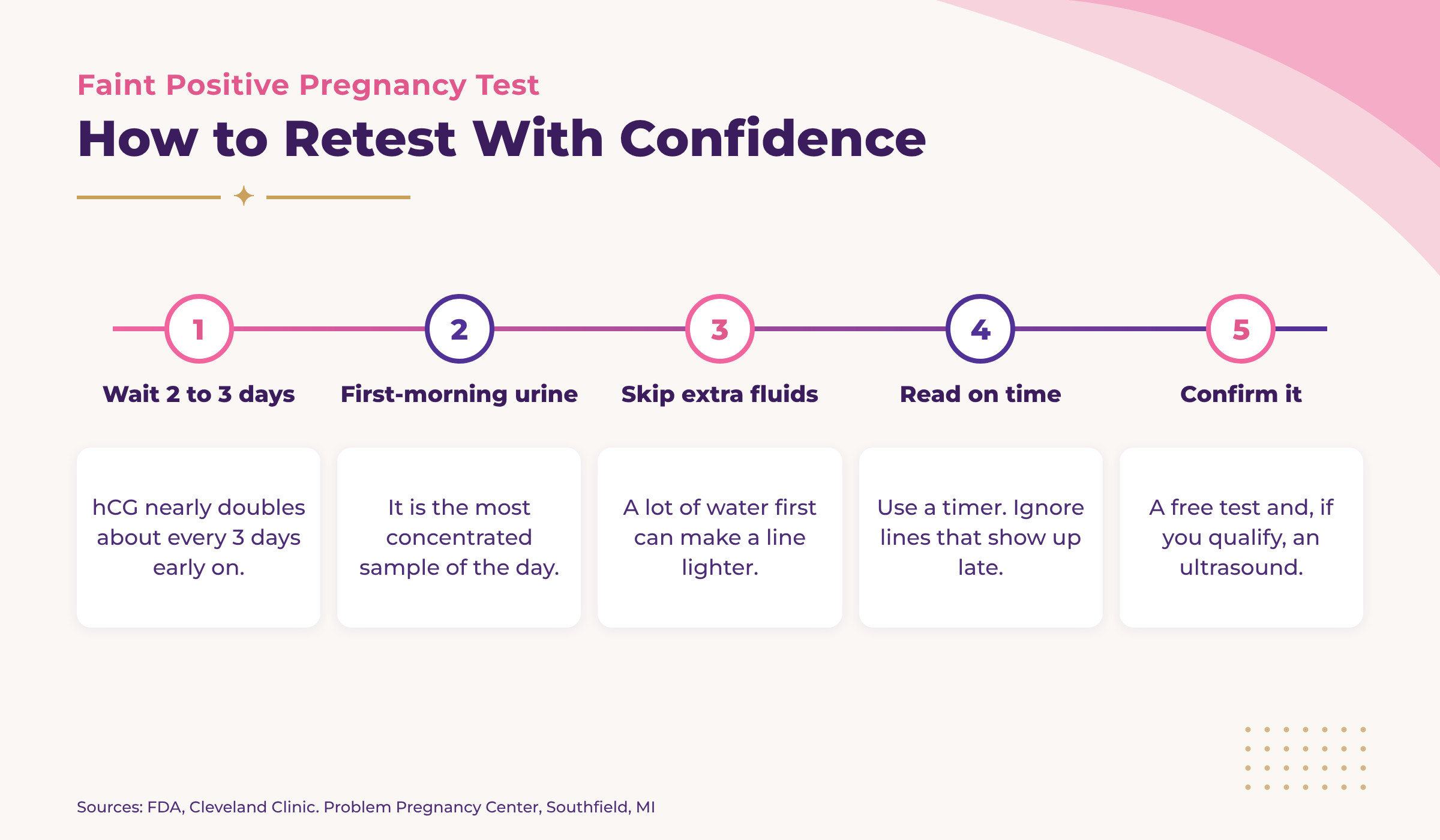
After a faint positive pregnancy test, a careful retest is often the simplest way to get a clearer result. The following approach is based on guidance from the FDA and Cleveland Clinic:
- Wait two to three days. This gives hCG time to rise if a pregnancy is developing.
- Use first-morning urine. It is usually the most concentrated sample of the day.
- Avoid extra fluids beforehand. Drinking a lot can dilute the hormone.
- Read the instructions first. Brands differ in how much urine to use and how long to wait.
- Set a timer. Read the result inside the stated window, then set the test aside.
- Consider testing after a missed period. The FDA notes that the most reliable results come 1 to 2 weeks after a missed period.
A digital test can be helpful if line tests are difficult to interpret, because it displays a written result instead of lines. Comparing a series of tests over several days may feel reassuring, but line darkness is not a reliable medical measure, and only an ultrasound can confirm how far along a pregnancy is.
Why confirm the pregnancy before making a decision?
When a pregnancy is unplanned, every option depends on a few facts that a home test cannot provide. Confirming them first gives you accurate information to make an informed decision.
| What you need to know | Why it matters | How we can help |
|---|---|---|
| Are you pregnant? | A faint line can reflect early testing, diluted urine or an evaporation line | Pregnancy confirmation |
| How far along are you? | Your options depend on how many weeks along you are | Limited ultrasound |
| Is the pregnancy in the uterus? | An ectopic pregnancy requires prompt medical care | Limited ultrasound |
| What are your options? | Accurate information helps you make an informed decision | Private options consultation |
Cleveland Clinic notes that home tests are about 99% accurate when used correctly, yet a test can only show whether hCG is present. Our articles on false positive pregnancy test causes and false negative pregnancy tests explain more about results that do not match.
When should you get medical care right away?
Certain symptoms in early pregnancy should be checked by a doctor promptly, and some require emergency care.
| Contact a doctor | Get emergency care now |
|---|---|
| Light spotting or bleeding of any kind | Heavy bleeding that soaks through pads |
| Mild cramping that keeps returning | Severe abdominal or pelvic pain, especially on one side |
| A test that stays faint for more than a week | Shoulder pain, fainting or extreme lightheadedness |
| Results that continue to contradict each other | Fever, chills or foul-smelling discharge |
Mayo Clinic advises seeking emergency help for severe abdominal or pelvic pain with vaginal bleeding, extreme lightheadedness or fainting, and shoulder pain, as these can be signs of an ectopic pregnancy.
If you experience any of these symptoms, call 911 or go to the nearest emergency room right away.
What to do next after a faint positive pregnancy test
A few practical steps can help you move from an uncertain result to a confirmed answer:
- Note the first day of your last menstrual period.
- Retest in two to three days using first-morning urine, and read the result within the stated time.
- Keep track of any bleeding, cramping or other symptoms and when they began.
- If the pregnancy is unplanned, schedule a confidential appointment to confirm it before making any decisions.
- Ask whether you qualify for a limited ultrasound to learn how far along you are.
- Allow yourself time to gather accurate information before deciding on next steps.
For more guidance on the first few days, read our article on what to do after a positive pregnancy test.
Confidential pregnancy services near Detroit
We are located in Southfield, MI, and serve women from Detroit, Oak Park, Royal Oak, Farmington Hills, Redford, Ferndale and nearby communities in Oakland, Wayne and Macomb counties.
For women facing an unplanned pregnancy, our services are free, confidential and require no insurance. They include pregnancy confirmation, a limited ultrasound for those who qualify and a private options consultation, where you can talk through your situation and your choices at your own pace.
Learn more about pregnancy testing in Southfield or request a free ultrasound.
Facing an unplanned pregnancy in Southfield?
A faint line rarely gives the complete picture. If this pregnancy was not planned, we can help you confirm it and, if you qualify, provide a limited ultrasound to show how far along you are.
Our services are free and confidential, with no insurance required. You will have a private place to get accurate information and talk through your options.
Frequently asked questions
Is a faint positive pregnancy test still positive?
A faint line that appears within the test’s reading window usually indicates that the test has detected hCG. Cleveland Clinic notes that even a faint line could mean you are pregnant, and retesting in two to three days with first-morning urine typically produces a clearer result.
Can a faint line pregnancy test be wrong?
A line that appears after the reading window may be an evaporation line, which is not a positive result. A faint positive can also be followed by a negative test if a very early pregnancy loss occurs, which is why reading the test on time and retesting are important.
How many days after a faint line should I test again?
Waiting two to three days is generally recommended. According to Cleveland Clinic, hCG nearly doubles about every three days in early pregnancy, which gives the hormone time to reach a level that is easier to detect. Use first-morning urine and read the result within the time stated in the instructions.
Does a faint pregnancy line on a test mean miscarriage?
A faint line on its own does not indicate a miscarriage. It usually means hCG levels are still low because the pregnancy is early. If a later test is negative or bleeding begins, contact a medical provider, and seek emergency care for heavy bleeding or severe pain.
Where can I confirm a pregnancy near Detroit?
If you are facing an unplanned pregnancy, Problem Pregnancy Center in Southfield, MI offers confidential pregnancy confirmation at no cost, along with a limited ultrasound for women who qualify. You can request an appointment online or call (734) 521-4441.
Sources
- Cleveland Clinic. Pregnancy Tests: When to Take, Types and Accuracy.
- Cleveland Clinic. Human Chorionic Gonadotropin (hCG).
- Cleveland Clinic. Chemical Pregnancy.
- U.S. Food and Drug Administration. Pregnancy (Home Use Tests).
- Mayo Clinic. Ectopic Pregnancy: Symptoms and Causes.


