

How long does the abortion pill take? For a woman facing an unplanned pregnancy, it is often one of the first questions she searches, usually alongside questions about what the process involves and how it affects her body.
This guide explains the process as leading medical sources describe it, from the first medication through the follow-up several weeks later, including what is typical and which symptoms require immediate care. It also explains why two facts should be confirmed before any decision: how far along a pregnancy is and where it is located. For women in Detroit, Southfield and across Metro Detroit, we can help you confirm both privately and at no cost.
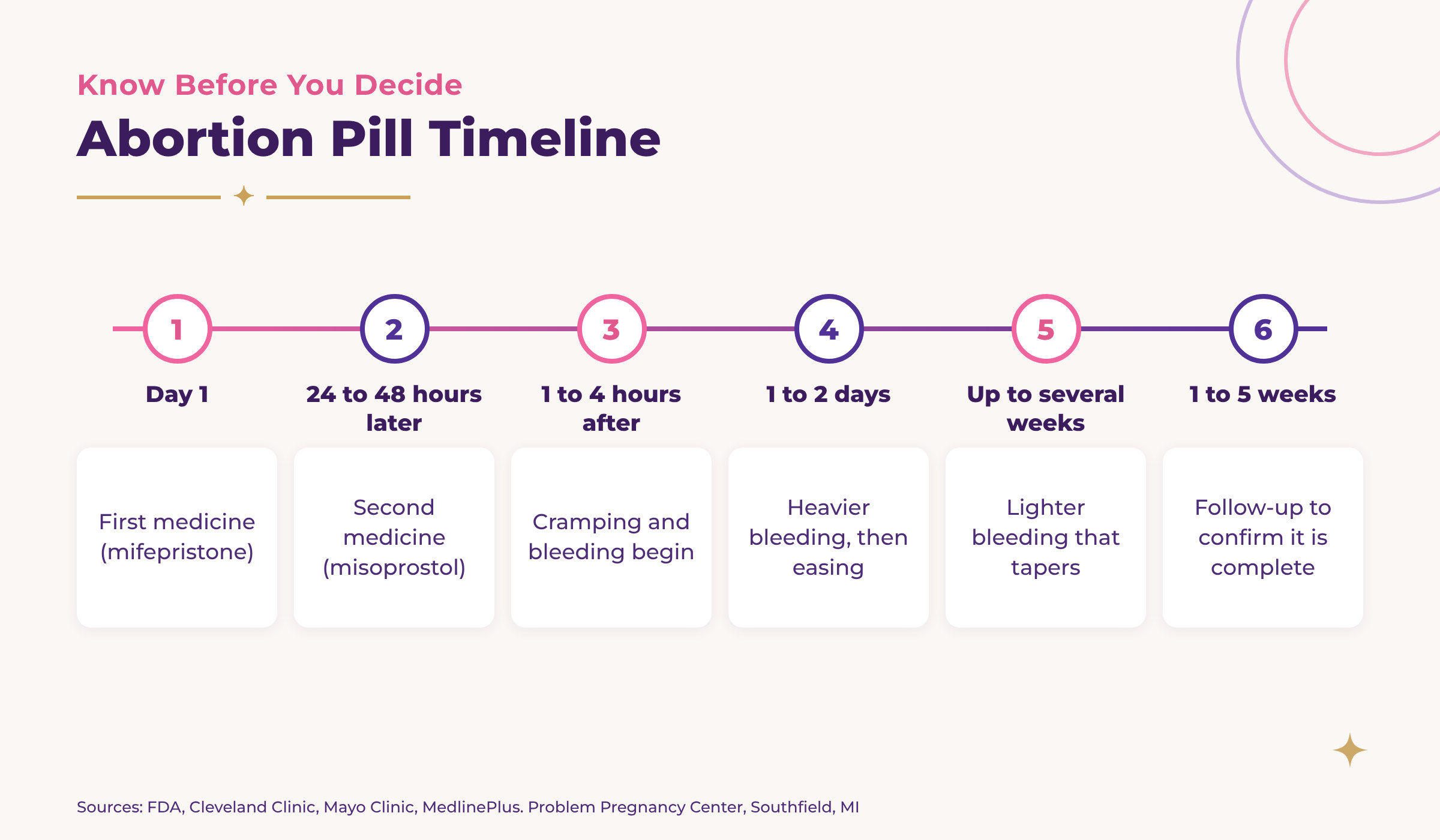
Quick answer: How long does the abortion pill take? The process uses two medications taken 24 to 48 hours apart. Bleeding and cramping usually begin one to four hours after the second medication, heavier bleeding can last one to two days and lighter bleeding can continue for several weeks, with a follow-up to confirm the process is complete.
How long does the abortion pill take from start to finish?
The answer depends on which part of the process is being measured. The most active phase typically lasts a day or two, while full recovery and confirmation take several weeks.
According to Cleveland Clinic, bleeding and cramping usually begin one to four hours after the second medication, and the pregnancy often passes within about two to six hours, although it can take longer. Heavier bleeding generally continues for one to two days, followed by lighter bleeding that can last several weeks, and a follow-up takes place one to five weeks later depending on the provider.
The table below summarizes each stage.
| Stage | Typical timing | What happens |
|---|---|---|
| First medication | Day 1 | Mifepristone blocks progesterone, the hormone a pregnancy needs |
| Second medication | 24 to 48 hours later | Misoprostol causes the uterus to cramp and empty |
| Bleeding begins | 1 to 4 hours after the second medication | Cramping and bleeding, often with clots |
| Pregnancy passes | Often 2 to 6 hours after the second medication | The heaviest bleeding and cramping |
| Heavier bleeding | 1 to 2 days | Bleeding similar to or heavier than a period |
| Lighter bleeding | Up to several weeks | Spotting or light bleeding that gradually tapers |
| Follow-up | 1 to 5 weeks | A call, visit or home test to confirm the process is complete |
| Next period | 4 to 6 weeks | The first period may be irregular |
These ranges vary from woman to woman, and each one assumes the pregnancy has already been confirmed and accurately dated. That first step is where we can help.
What are the two medications, and how do they work?
The abortion pill is a two-step process. MedlinePlus, from the National Library of Medicine, describes it as the use of two prescription medications, mifepristone and misoprostol.
Mifepristone, the first medication, blocks progesterone, the hormone a pregnancy needs to continue developing. Misoprostol is taken 24 to 48 hours later, according to the FDA, and causes the uterus to contract and empty, which is when most bleeding and cramping occur.
Dosing is determined by a licensed medical provider and is not covered in this article.
Abortion pill: what to expect hour by hour
Understanding the typical sequence can make the process easier to follow. Based on the sources above, the first day after the second medication often unfolds in three stages.
The first few hours. Cramping and bleeding usually begin one to four hours after misoprostol, and Cleveland Clinic describes the cramps as similar to strong menstrual cramps.
The most intense stretch. Over the following several hours, cramping peaks and bleeding becomes heavier, often with clots. This is usually when the pregnancy passes.
The rest of the day. Cramping generally eases once the uterus has emptied, although bleeding often remains heavier than a normal period for a day or two.
Other side effects are common on the same day. Cleveland Clinic lists nausea, diarrhea, dizziness and fatigue, as well as a low fever or chills that can last about a day, and MedlinePlus notes that physical recovery most often takes place within a few days.
How much cramping after the abortion pill is typical?
Cramping after the abortion pill is expected and is usually strongest during the first several hours. Once the pregnancy passes, cramps typically ease to something closer to menstrual cramps.
MedlinePlus notes that mild cramping and some bleeding can continue for a few days, and Cleveland Clinic adds that bleeding typically lessens over two to three weeks. The table below compares what medical sources describe as typical with the symptoms that require prompt attention.
| Described as typical | Contact a medical provider right away |
|---|---|
| Cramping similar to strong menstrual cramps for several hours | Severe abdominal or pelvic pain that does not ease |
| Bleeding heavier than a period for one to two days | Soaking two or more pads an hour for two hours in a row |
| Clots during the heaviest bleeding | No bleeding at all 24 hours after the second medication |
| Low fever or chills for about a day | Fever lasting more than 24 hours, or fever that begins days later |
| Light bleeding or spotting for several weeks | Foul-smelling discharge, a rapid heart rate or body aches |
The pad guideline comes from Mayo Clinic, while the fever and no-bleeding guidelines come from Cleveland Clinic. Any symptom that raises concern should be discussed with a medical provider.
Why confirm the pregnancy before any decision?
When a pregnancy is unplanned, several important questions should be answered before any decision is made, and a home test can address only the first of them.
| What you need to know | Why it matters | How we can help |
|---|---|---|
| Are you pregnant? | Home tests can be read too early or misread | Pregnancy confirmation |
| How far along are you? | The medications are approved only through 10 weeks | Limited ultrasound |
| Is the pregnancy in the uterus? | An ectopic pregnancy requires prompt medical care | Limited ultrasound |
| What are your options? | Accurate information supports an informed decision | Private options consultation |
Timing matters because the medications have limits. The FDA approves this regimen through 70 days, or 10 weeks, after the first day of the last menstrual period, and Mayo Clinic notes it should not be attempted after 11 weeks.
Dating a pregnancy from the last period alone can be inaccurate, since cycles vary and many women are unsure of the exact date. Mayo Clinic notes that an ultrasound can show how far along a pregnancy is and confirm that it is inside the uterus.
Location also matters for safety. The FDA lists a confirmed or suspected ectopic pregnancy as a reason not to use these medications, and Mayo Clinic notes that an untreated ectopic pregnancy can cause life-threatening bleeding. Our guide to the signs of ectopic pregnancy explains what to watch for.
If you are worried you could be pregnant and are unsure how far along you are, our Southfield center offers a limited ultrasound at no cost to women who qualify. You can request an ultrasound appointment and discuss your situation in private.
What follow-up confirms the process is complete?
Follow-up is an important part of the overall timeline. MedlinePlus describes it as essential for confirming that the process is complete and that all tissue has passed.
The timing depends on the provider. The FDA recommends follow-up about 7 to 14 days after the first medication, while Mayo Clinic describes a phone or online check one to two weeks later, followed by a home urine pregnancy test about four weeks later.
The medications are not effective in every case. Cleveland Clinic reports the combination is about 98% effective, and MedlinePlus notes that an additional dose or a procedure may be needed when it does not work. Continuing pregnancy symptoms, or no period within two months, should be reported to a medical provider.
When should you get medical care right away?
Call 911 or go to the nearest emergency room right away if any of the following occur:
- Bleeding that soaks two or more pads an hour for two hours in a row
- Severe pain in the abdomen, pelvis or back
- Fainting, extreme dizziness or a racing heart
- Fever that lasts more than 24 hours
- Foul-smelling discharge, chills or body aches
- Sudden one-sided pain or shoulder pain, which can signal an ectopic pregnancy
Before making a decision: a short checklist
Whether you are gathering information or weighing a decision, the following steps can help you prepare with accurate facts:
- Confirm the pregnancy. A confirmed result is the starting point for every option.
- Find out how far along you are. An ultrasound provides a more reliable date than a period calendar.
- Confirm the location. An ultrasound can show whether the pregnancy is in the uterus.
- Understand Michigan’s rules. Our article on what to know before taking the abortion pill in Michigan covers state-specific questions.
- Know the warning signs. Keep the symptom table above somewhere easy to find.
- Talk it through privately. A confidential options consultation gives you space to ask questions and consider each choice carefully.
Where can I get an ultrasound near Detroit?
We are located in Southfield, MI, and serve women from Detroit, Oak Park, Royal Oak, Farmington Hills, Dearborn, Livonia and nearby communities in Oakland, Wayne and Macomb counties.
For women facing an unplanned pregnancy, our services are free, confidential and require no insurance. They include pregnancy confirmation, a limited ultrasound for those who qualify and a private options consultation, and many women visit us first to learn how far along they are before making any decision.
You can read more about the abortion pill in Southfield, MI or review all of our pregnancy services.
Facing an unplanned pregnancy in Southfield?
Understanding the abortion pill timeline is only part of the picture. Before any decision, it is important to know that you are pregnant, how far along you are and that the pregnancy is in the uterus.
If this pregnancy was not planned, we offer confidential pregnancy confirmation, a limited ultrasound for women who qualify and a private options consultation, all at no cost and at a pace that works for you.
Frequently asked questions
How long does the abortion pill take to work?
According to Cleveland Clinic, bleeding and cramping usually begin one to four hours after the second medication, and the pregnancy often passes within about two to six hours. Heavier bleeding can last one to two days, and lighter bleeding can continue for several weeks.
How long does cramping after the abortion pill last?
The strongest cramping usually occurs during the first several hours after the second medication. Once the pregnancy passes, cramps typically ease to a level similar to menstrual cramps, and MedlinePlus notes that mild cramping can continue for a few days.
How long does bleeding last after the abortion pill?
Cleveland Clinic describes heavier bleeding for one to two days, followed by lighter bleeding that tapers over two to three weeks. Soaking two or more pads an hour for two hours in a row requires emergency care.
How far along can you be to take the abortion pill?
The FDA approves the regimen through 70 days, or 10 weeks, after the first day of the last menstrual period. Mayo Clinic notes that it should not be attempted after 11 weeks, which is why an accurate date from an ultrasound is important.
Where can I find out how far along I am near Detroit?
For women facing an unplanned pregnancy, Problem Pregnancy Center in Southfield, MI offers confidential pregnancy confirmation and a limited ultrasound for those who qualify, at no cost. You can request an appointment online or call (734) 521-4441.
Sources
- Cleveland Clinic. Medical Abortion: What It Is, Pain, Risks and Recovery.
- U.S. Food and Drug Administration. Questions and Answers on Mifepristone for Medical Termination of Pregnancy Through Ten Weeks Gestation (content current as of April 8, 2026).
- MedlinePlus, U.S. National Library of Medicine. Abortion, Medication.
- Mayo Clinic. Medical Abortion.
- Mayo Clinic. Ectopic Pregnancy: Symptoms and Causes.


