
Light spotting a few days before a period is due often raises an immediate question: is this the start of a period, or could it be an early sign of pregnancy? Understanding implantation bleeding vs period differences can help, particularly when a pregnancy would be unexpected.
The two can look similar at first and often occur around the same time, yet they differ in timing, color, flow and duration. This guide outlines seven of those differences using trusted medical sources and explains why only a pregnancy test, taken at the right time, can provide a reliable answer. For women in Detroit, Southfield and across Metro Detroit facing a possible unplanned pregnancy, we can help confirm the result privately and at no cost.
Quick answer: The key implantation bleeding vs period differences are color, flow and duration. Implantation bleeding is light pink or brown spotting about 10 to 14 days after ovulation that usually stops within two days, while a period is red, steadier and lasts three to seven days. A test after a missed period confirms pregnancy.
What is implantation bleeding?
Implantation bleeding is light spotting that can occur when a fertilized egg attaches to the lining of the uterus. According to Cleveland Clinic, it is one of the earliest possible signs of pregnancy, and about one in four pregnant women experience it.
Mayo Clinic explains that it typically happens about 10 to 14 days after conception. Because this often falls close to when a period is expected, the two are easily confused.
Implantation bleeding vs period: 7 differences at a glance
Timing, color, flow and duration offer the clearest clues. The table below brings all seven differences together.
| Difference | Implantation bleeding | Period |
|---|---|---|
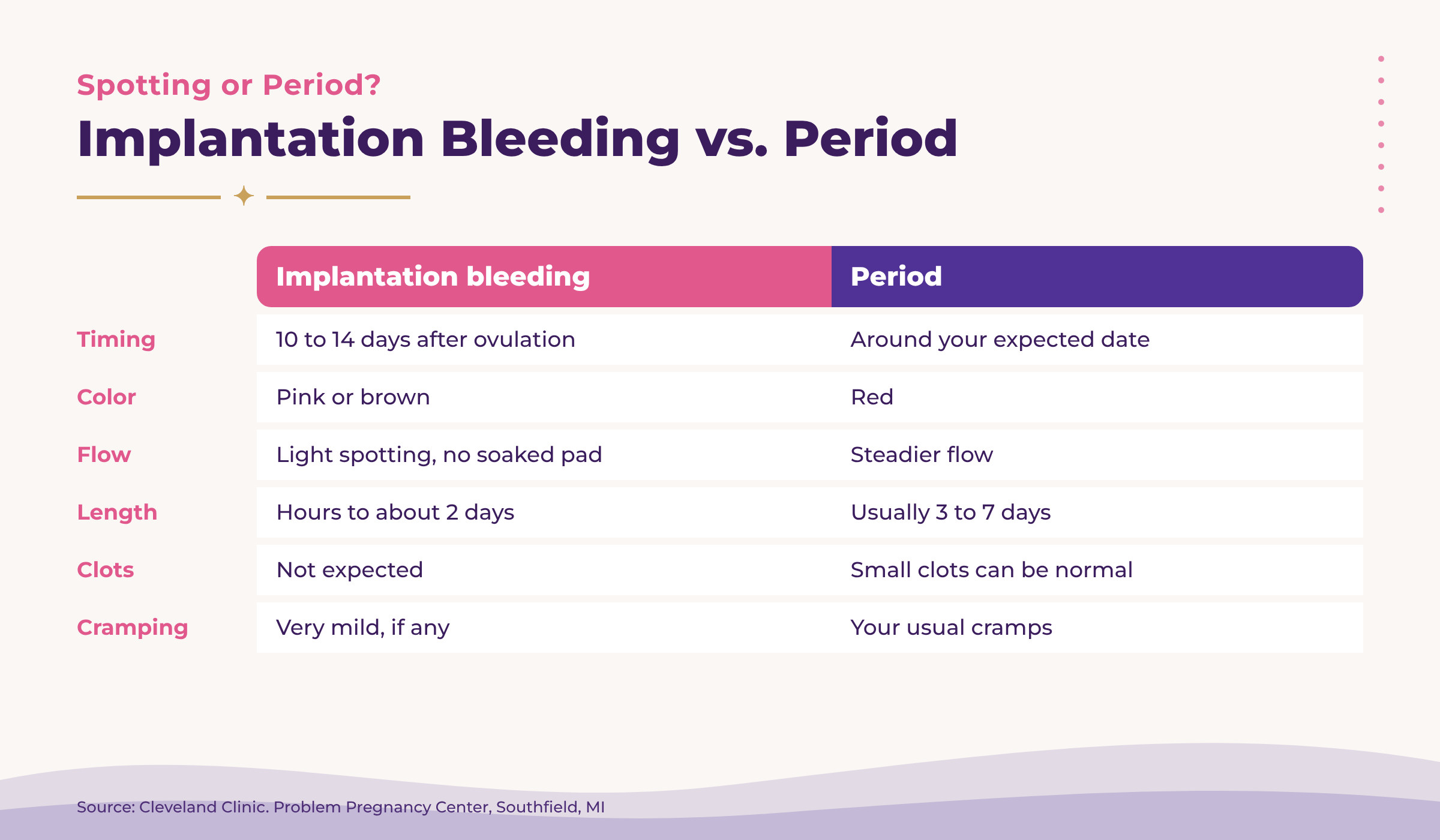
| 1. Timing | About 10 to 14 days after ovulation, often a few days before a period is due | Around the expected date, about every 21 to 35 days |
| 2. Color | Pink, brown or dark brown | Usually bright to dark red |
| 3. Flow | Light spotting that should not soak a pad | A steadier flow that requires a pad or tampon |
| 4. Duration | A few hours to about two days | Usually three to seven days |
| 5. Clots | Not expected | Small clots can be normal |
| 6. Cramping | Very mild, if any | Typical menstrual cramps |
| 7. What follows | Possible early pregnancy symptoms and a missed period | The next cycle begins |
The sections that follow explain each difference in more detail, along with the source behind it.
How does the timing compare?
Timing is often the first clue. Cleveland Clinic notes that implantation bleeding usually occurs about 10 to 14 days after ovulation, before most women would notice a missed period.
A typical cycle lasts about 28 days, and Cleveland Clinic describes a normal range of about 21 to 35 days. Since ovulation occurs roughly midway through the cycle, implantation tends to fall shortly before a period would begin.
As a result, spotting that arrives a few days early could be either one, and timing alone rarely settles the question. Noting the date can be helpful when you later confirm the result.
What do color and flow tell you?
Color and flow are two of the most useful indicators when comparing implantation bleeding vs period.
Color. Cleveland Clinic describes implantation bleeding as pink, brown or dark brown, whereas menstrual blood is usually red, particularly once the flow increases.
Flow. Implantation bleeding is light spotting that typically appears on toilet paper or underwear and should not soak through a pad. A period, by contrast, usually begins lightly and then becomes a steady flow that requires a pad or tampon.
Cleveland Clinic also notes that bright or dark red blood, a heavy flow or clots usually point to something other than implantation bleeding.
How long does each one last?
Duration is one of the more reliable differences. Cleveland Clinic notes that implantation bleeding can last from a few hours to a few days and should stop on its own within about two days, while most periods last about three to seven days.
Your own typical cycle is the best point of comparison. Light bleeding that continues beyond a couple of days or becomes heavier is more likely a period or another type of bleeding.
Do clots and cramping help tell them apart?
Both can offer useful clues. Clots are not expected with implantation bleeding, according to Cleveland Clinic, while small clots during a period can be normal. Clots larger than a quarter are among the signs Cleveland Clinic lists as irregular bleeding.
Cramping also tends to differ. Cleveland Clinic notes that any cramping associated with implantation bleeding should be very mild and less intense than menstrual cramps, and many women notice none at all. Strong cramping together with light bleeding should be discussed with a doctor rather than assumed to be implantation.
If you are worried you could be pregnant and the timing is not right for you, our Southfield center offers confidential pregnancy confirmation at no cost. You can request an appointment online.
Spotting vs implantation bleeding: is there a difference?
Many women search for spotting vs implantation bleeding as though they were two separate things. Cleveland Clinic describes implantation bleeding as very light bleeding, also called spotting, which makes implantation one possible cause of spotting rather than the only one.
Spotting between periods can have many causes. Mayo Clinic lists shifting hormone levels, certain medications, infections and polyps among them. The pattern linked to implantation is its timing, about 10 to 14 days after ovulation and near the expected period.
Other early symptoms, such as breast tenderness or fatigue, can also overlap with an upcoming period. Our guide to PMS vs. pregnancy symptoms compares 10 of them, and our article on the early signs of pregnancy describes what to expect.
Why can’t symptoms give a definite answer?
Even with all seven differences in mind, bleeding alone cannot confirm whether a pregnancy has begun. The ranges overlap, and individual cycles vary considerably.
Some women have a very light period, while others experience spotting for reasons unrelated to pregnancy. Cleveland Clinic also notes that bleeding in early pregnancy can result from miscarriage or an ectopic pregnancy, both of which require medical care. For these reasons, a pregnancy test taken at the right time is the clearest next step.
When will a pregnancy test give a reliable answer?
Testing too early is the most common reason for a misleading result. Cleveland Clinic explains that many home tests can detect hCG about 10 days after conception, but waiting until after a missed period produces a more accurate result.
During implantation bleeding itself, a home test will probably be negative because hCG levels are still low. For the clearest answer, wait until the spotting has stopped and the period is late.
When used correctly at the right time, home tests are about 99% accurate. If a test is negative and the period still does not arrive, our article on a missed period with a negative test explains possible reasons, and our guide to a faint positive pregnancy test explains what a light second line can mean.
Why confirm the pregnancy before making a decision?
When a pregnancy is unplanned, every option depends on a few facts that spotting and home tests cannot provide. Confirming them first gives you accurate information to make an informed decision.
| What you need to know | Why it matters | How we can help |
|---|---|---|
| Are you pregnant? | Spotting can be implantation, a light period or another cause | Pregnancy confirmation |
| How far along are you? | Your options depend on how many weeks along you are | Limited ultrasound |
| Is the pregnancy in the uterus? | An ectopic pregnancy requires prompt medical care | Limited ultrasound |
| What are your options? | Accurate information supports an informed decision | Private options consultation |
When should you call a doctor or get emergency care?
Certain types of bleeding should be checked by a doctor promptly, and some require emergency care.
| Contact a doctor soon | Get emergency care now |
|---|---|
| Spotting with a positive pregnancy test | Heavy bleeding that soaks through pads |
| Bleeding that lasts longer than usual | Severe abdominal or pelvic pain, especially on one side |
| Bleeding with clots or unusual cramping | Shoulder pain, fainting or extreme lightheadedness |
| Recurring spotting between periods | Bleeding with fever or chills |
Mayo Clinic advises contacting a provider about any vaginal bleeding during pregnancy, and Mayo Clinic lists severe pelvic pain with bleeding, shoulder pain and fainting as emergency signs of a possible ectopic pregnancy.
If you experience any of these symptoms, call 911 or go to the nearest emergency room right away.
What to do next
The following steps can help you move from uncertain spotting to a clear answer:
- Note the details. Record the date, color, amount and duration of the bleeding.
- Compare it with your usual period. Your own pattern is the most useful reference.
- Test at the right time. Wait until the spotting stops and your period is late.
- Confirm the result. If the pregnancy would be unplanned, schedule a confidential appointment to confirm it.
- Know the warning signs. Use the table above to recognize when to call a doctor or seek emergency care.
- Gather accurate information first. A private options consultation gives you space to consider each choice carefully.
Where can I confirm a pregnancy near Detroit?
We are located in Southfield, MI, a short drive from Detroit, and serve women from Oak Park, Royal Oak, Farmington Hills, Dearborn, Livonia and nearby communities in Oakland, Wayne and Macomb counties.
For women in Michigan facing an unplanned pregnancy, our services are free, confidential and require no insurance. They include pregnancy confirmation, a limited ultrasound for those who qualify and a private options consultation.
Learn more about pregnancy testing in Southfield or review all of our pregnancy services.
Facing an unplanned pregnancy in Southfield?
Spotting rarely provides a definite answer. If you are worried you could be pregnant, we can help you confirm the result and, if you qualify, provide a limited ultrasound to show how far along you are.
Our services are free and confidential, with no insurance required, and you will have a private place to get accurate information and talk through your options.
Frequently asked questions
What is the main difference in implantation bleeding vs period?
Implantation bleeding is light pink or brown spotting that usually stops within about two days and should not soak a pad. A period is typically red, develops into a steadier flow and lasts about three to seven days.
How soon after implantation bleeding can I take a pregnancy test?
A home test is likely to be negative during implantation bleeding because hCG levels are still low. Cleveland Clinic suggests waiting until the bleeding stops and the period is late for the most accurate result.
Can implantation bleeding be heavy or include clots?
According to Cleveland Clinic, implantation bleeding is light and should not include clots. Heavy bleeding or clots usually indicate a period or another cause, and heavy bleeding during pregnancy requires medical care.
What is the difference between spotting vs implantation bleeding?
Implantation bleeding is one type of spotting. Spotting refers to any light bleeding outside a normal period, and Mayo Clinic lists causes such as hormone changes, certain medications, infections and polyps, whereas implantation spotting tends to occur about 10 to 14 days after ovulation.
Where can I confirm a pregnancy near Detroit?
For women facing an unplanned pregnancy, Problem Pregnancy Center in Southfield, MI offers confidential pregnancy confirmation at no cost, along with a limited ultrasound for those who qualify. You can request an appointment online or call (734) 521-4441.
Sources
- Cleveland Clinic. Implantation Bleeding.
- Mayo Clinic. Symptoms of Pregnancy: What Happens First.
- Cleveland Clinic. Menstrual Cycle (Normal Menstruation).
- Cleveland Clinic. Pregnancy Tests: When to Take, Types and Accuracy.
- Mayo Clinic. Vaginal Bleeding: Causes.
- Mayo Clinic. Implantation Bleeding: Common in Early Pregnancy?
- Mayo Clinic. Ectopic Pregnancy: Symptoms and Causes.


